



The Defence Acquisition Council’s latest approvals worth more than Rs 52,000 crore are not merely another round of military purchases. They offer perhaps the clearest indication yet that India’s armed forces are recalibrating for a battlespace where information, autonomy and electronic dominance will matter as much as firepower.
From Fixed-Wing Based High Altitude Pseudo Satellites (FW-HAPS) and jet-powered loitering munitions to advanced unmanned systems, layered air defence and counter-drone capabilities, the acquisitions reflect lessons drawn from Operation Sindoor. More importantly, they reinforce a longer-term transition already underway – one that seeks to build persistent Intelligence, Surveillance and Reconnaissance (ISR), compress the sensor-to-shooter cycle and improve decision-making across all domains of warfare.
For Rear Admiral Sudarshan Y. Shrikhande (Retd.), the latest approvals should not be viewed as a dramatic policy departure but as a continuation of an evolving technological shift driven by changing threats.
“Today, the threat from drones, missiles and other unmanned platform-weapon combinations is increasing. That’s the specific driver,” he says.
While AI-enabled ISR, autonomous combat systems, space-based assets and electronic warfare are increasingly finding their way into India’s procurement priorities, Shrikhande believes the pace now needs to accelerate.
“Priority has been given to these areas over the past few years, but faster research and development, quicker technological maturation and, wherever necessary, rapid procurement will be essential. I won’t say this DAC approval is the beginning, but certainly a continuation.”
His assessment reflects a broader reality confronting militaries worldwide like in the Russia-Ukraine and Iran-US and Israel conflicts. The decisive advantage in future conflicts will increasingly belong to the side that can detect first, process information fastest and strike before the adversary can react. That demands an ecosystem rather than individual platforms.
The Navy’s growing emphasis on shipborne unmanned aerial systems illustrates that trend. According to strategist and scholar Shrikhande, such platforms have already become integral to naval operations and will only expand in numbers and capability as they are for other Services. These are extensions of sensors and/or the ability to strike enemy assets at sea and from the sea. Recent conflicts in the Black Sea and the Middle East have demonstrated how unmanned systems are transforming naval warfare, making India’s investment both timely and operationally necessary.
Former Air Officer Commanding-in-Chief of Central Air Command, Air Marshal R.G.K. Kapoor (Retd.), argues that the Indian military is now moving beyond conventional reconnaissance towards an integrated ISR architecture built around endurance, networking and artificial intelligence.
Conventional reconnaissance aircraft, he notes, are constrained by endurance, operating costs, manpower requirements and survivability in contested airspace. Advanced UAVs, by contrast, combine long endurance with edge computing, AI-enabled sensors, communication relay functions and seamless network integration, delivering significantly greater operational output at lower cost.
Air Marshal Kapoor advises against considering unmanned platforms as independent capabilities. Instead, he emphasises that they are part of a broader Intelligence, Surveillance, and Reconnaissance (ISR) ecosystem, which aims to provide commanders with ongoing situational awareness at strategic, operational, and tactical levels. These platforms can remain airborne for extended periods while safely operating within friendly airspace, enabling continuous surveillance without risking valuable assets to hostile air defences.
The same philosophy is evident in India’s evolving approach to air defence. The proliferation of drones, cruise missiles, precision-guided weapons and autonomous swarms has fundamentally altered the nature of aerial threats. Conventional missile-based systems alone cannot provide adequate protection.
Kapoor believes that future air defence architecture should increasingly integrate both kinetic and non-kinetic capabilities. Electronic warfare and Directed Energy Weapons (DEWs), such as high-energy lasers and high-powered microwave systems, are becoming essential tools for countering drone swarms and autonomous platforms. Unlike traditional missile systems, these technologies provide virtually unlimited engagement capacity without concerns about ammunition expenditure or reload cycles, making them especially effective against massed unmanned attacks.
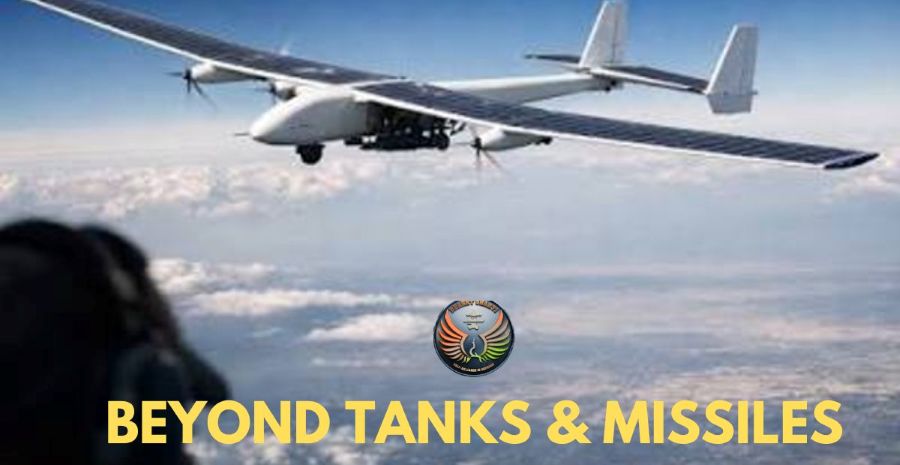
Among the DAC approvals, the decision to acquire Fixed-Wing High Altitude Pseudo Satellites could prove one of the most consequential.
Operating in the near-space region between conventional aircraft and satellites, HAPS combine the endurance of space assets with the flexibility of airborne platforms. Solar-powered and capable of remaining aloft for weeks or even months, they can provide uninterrupted surveillance over designated areas while simultaneously serving as communication relays.
According to Kapoor, persistent surveillance is the defining requirement of modern ISR. Satellites, aircraft and conventional UAVs each offer distinct strengths but also leave coverage gaps. HAPS bridge those gaps by delivering continuous “stare” capability over sensitive areas, reducing the sensor-to-shooter loop when integrated with AI-enabled command networks. Their operating altitude also makes them difficult for conventional radar systems to detect and challenging for most air defence systems to engage.
Beyond surveillance, these platforms could extend the operational reach of UAVs, support secure communications for swarm drones and provide theatre commanders with flexible ISR assets that can be rapidly redeployed between sectors.
The technological challenge, however, remains formidable.
While Indian industry has demonstrated the capability to build fixed-wing airframes, Kapoor believes the more difficult task lies elsewhere -developing lightweight, high-efficiency solar cells, advanced batteries and sophisticated ISR and communication payloads capable of operating for prolonged periods at extreme altitudes.
Given the relatively small numbers to start with, 50, what IAF is initially looking for, he suggests that India may have to adopt a phased approach by importing select high-end components while indigenous capability matures. Such pragmatism, he argues, could accelerate operational induction without compromising the broader objective of technological self-reliance.
The latest DAC approvals, therefore, represent more than an acquisition programme. They point towards a future force structure built around persistent sensing, autonomous systems, resilient communications and integrated decision-making. Operation Sindoor may have accelerated this shift, but sustaining it will depend less on procurement approvals and more on India’s ability to build a domestic ecosystem capable of delivering advanced sensors, AI-enabled payloads, electronic warfare systems and near-space technologies at operational scale. That, ultimately, will determine whether India merely acquires the technologies of future warfare or masters them.
Ravi Shankar

Dr Ravi Shankar has over two decades of experience in communications, print journalism, electronic media, documentary film making and new media.
He makes regular appearances on national television news channels as a commentator and analyst on current and political affairs. Apart from being an acknowledged Journalist, he has been a passionate newsroom manager bringing a wide range of journalistic experience from past associations with India’s leading media conglomerates (Times of India group and India Today group) and had led global news-gathering operations at world’s biggest multimedia news agency- ANI-Reuters. He has covered Parliament extensively over the past several years. Widely traveled, he has covered several summits as part of media delegation accompanying the Indian President, Vice President, Prime Minister, External Affairs Minister and Finance Minister across Asia, Africa and Europe.