



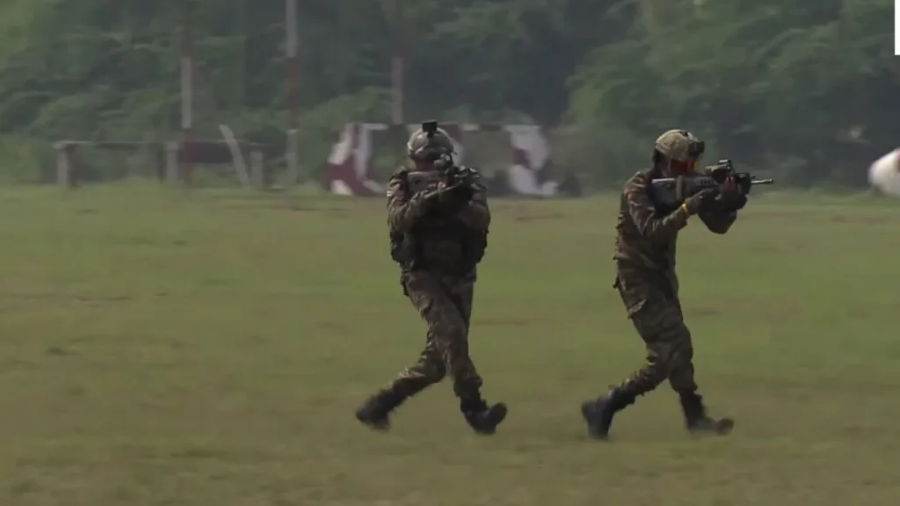
The United Nations Troop Contributing Countries’ (UNTCC) Chiefs Conclave 2025, hosted by the Indian Army from October 14 to 16, witnessed a powerful blend of innovation, strategy, and international solidarity. A major highlight of the conclave was the chiefs’ visit to Agra, where the Indian Army demonstrated cutting-edge defence technologies tailored for modern peacekeeping missions.
The Integrated New Age Technology Demonstration showcased a range of next-generation equipment developed under India’s Atmanirbhar Bharat (self-reliant India) initiative. From unmanned systems and AI-enabled surveillance to mobile counter-drone solutions, the presentation highlighted India’s growing capability to field innovative, cost-effective technologies for peacekeeping and high-risk operational environments.
The showcase not only underlined India’s domestic defence progress but also positioned it as a reliable partner in strengthening United Nations peacekeeping frameworks, not just through troop contributions, but through tailored, mission-ready solutions for today’s complex operational theatres.
South American Nations Highlight Operational Depth and Long-Term Commitment
Amid the conclave’s discussions, two South American nations, Uruguay and Brazil, stood out for their longstanding and operational contributions to UN peacekeeping missions. Their military leaders shared experiences shaped by decades in the field, offering insights into both the human and tactical dimensions of global peace support operations.
Uruguay: “Peacekeeping Must Always Centre on Protecting People”
Gen Mario R. Stevenazzi, Commander-in-Chief of the Uruguayan Army, stated an unwavering commitment to peacekeeping, dating back to 1933 with the deployment of military observers, and a continuous presence since 1952 in over 30 missions.
“Uruguay has demonstrated the highest respect and commitment to United Nations-led Peacekeeping Operations, viewing them as a necessary and fundamental tool to ensure the management of very painful processes for regions, and most importantly, for people.”
He outlined Uruguay’s current deployments, including a battalion in the Democratic Republic of the Congo, a reinforced company on the Golan Heights, and military observers across eight countries. Additionally, Uruguay maintains a Special Transport and Engineer Group in the Sinai Peninsula under the Camp David Treaty framework.
He acknowledged that peacekeepers often operate in shifting, fragile conditions.
“When the situation gets out of control, the Blue Helmets provide security guarantees for the safe evacuation of all agencies. They must continue to fulfil their mission even when the context indicates that the risk is very high.”
He stressed the importance of experienced leadership, joint planning, strong command structures, and the participation of troop-contributing countries in UN decision-making during crises.
Uruguay, he added, has taken an active role in the Women, Peace and Security agenda, and has been a pioneer in implementing the ELSIE initiative, identifying and addressing barriers to women’s participation in peace operations.
“Neutrality and impartiality are essential, but in the most critical moments, the Blue Helmets often become the last standing witnesses for the protection of life and dignity.”
Brazil: “Peacekeeping is About Preparedness, Partnership, and Purpose”
Echoing Uruguay’s dedication, General Eduardo, Vice Chief of Staff of the Brazilian Army, spotlighted Brazil’s broad peacekeeping legacy, with over 44,000 troops deployed in 10 missions since 1957. He noted Brazil’s 13-year leadership of the UN Stabilisation Mission in Haiti (MINUSTAH) as a defining contribution.
“Peacekeeping has provided important lessons not only in operations, but in logistics, doctrine, and planning. These challenges have led to constant improvements in how we prepare and deploy our contingents.”
Brazil now places strong emphasis on peacekeeping training and knowledge-sharing through its Peacekeeping Operations Joint Centre, which offers a wide array of specialised courses to personnel from friendly nations — including on civilian protection, civil-military coordination, sexual exploitation and abuse prevention, and mine action.
“Many armies represented at this Conclave have already worked together in the field. Today, we reaffirm our commitment to deepen those partnerships through joint preparation and training.”
Brazil’s efforts also align with the UN’s goals on gender parity, with the Brazilian Army actively promoting women’s participation in peacekeeping roles, both in domestic training programs and in international deployments.
“The Brazilian Army remains committed to sending troops capable of participating in Peacekeeping Operations and humanitarian actions. Our mission is to ensure that the Peacekeepers of the future are well-prepared to bring peace and stability to the regions the UN serves.”
Technology, Experience, and Unity of Purpose
The 2025 UNTCC Chiefs Conclave was not just a forum for ceremonial engagement; it reflected a maturing conversation around the future of peacekeeping. With the global security environment evolving rapidly, the convergence of technology, leadership experience, and cross-regional collaboration will be essential.
India’s defence technology showcase illustrated its growing role in supporting peacekeeping operations through innovation.
Huma Siddiqui