Defence Minister Rajnath Singh has approved the transfer of technologies developed by the Defence Research and Development Organisation (DRDO) for all conventional missile systems to Indian defence companies, in a move that could significantly expand private-sector participation in missile production.
The Ministry of Defence said on Tuesday that Indian companies meeting the prescribed qualifications, certifications and regulatory requirements will be able to undertake production of DRDO-developed conventional missile systems in the country.
Officials in the defence establishment said the conventional portfolio includes the Akash and Akash-NG surface-to-air missile systems, VSHORADS, Astra air-to-air missiles, the Rudram anti-radiation family, and anti-tank systems such as Nag, SANT and the man-portable ATGM. The portfolio also covers the NASM-SR anti-ship missile, indigenous land-attack cruise missiles and Pralay, the quasi-ballistic weapon designed for conventional strikes.
Strategic missiles remain outside the scope of the decision and will continue to be handled separately. The Agni series and K-series, therefore, are not part of the technology transfer. BrahMos and MRSAM are also excluded as they involve foreign partners and are governed by separate arrangements, an official said.
The decision marks a further shift from the traditional model under which a DRDO missile, after completing development and user trials, was assigned to a nominated production agency for series manufacture. State-run Bharat Dynamics Ltd (BDL) has traditionally played that role for much of India’s indigenous missile portfolio.
Private Industry Gets a Larger Role
The move also builds on the government’s decision earlier this year to open tactical missile production to private industry under the Development-cum-Production Partner (DcPP) model. Under the model, private companies enter programmes during development rather than being brought in only after a system has completed development and trials.
DRDO has distributed around 10 to 12 tactical missile programmes to public and private companies, with Adani Defence, Bharat Forge, ICOMM Tele, and Solar Defence and Aerospace designated as DcPP.
Adani Defence is the DcPP for the Rudram anti-radiation missile series, including the hypersonic Rudram-II, which is planned for production at its Hyderabad facility. It is also the DcPP for NASM-SR.
Bharat Forge and Adani are also DcPPs for the 1,000-kg-class Gaurav long-range glide bomb and the TARA glide kit. Adani Defence broke ground last month on a Rs 2,500-crore missile complex at Shivpuri in Madhya Pradesh, where composite-propellant and TNT production are planned.
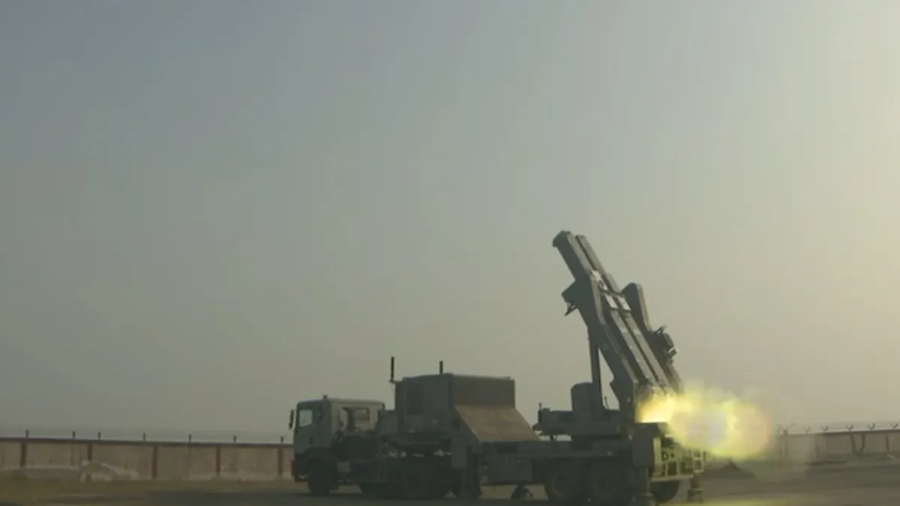
Several of these programmes have also advanced through flight and release trials this year. DRDO conducted the maiden salvo launch of NASM-SR from a Navy Sea King helicopter off Odisha in April, firing two missiles in quick succession.
The agency conducted the maiden flight trial of TARA from an Indian Air Force Jaguar in May, converting a 500-kg bomb into a guided stand-off weapon. Gaurav has completed release trials with the Su-30MKI at a distance of close to 100 km.
The Astra Mk-2, with a range of more than 200 km, is also understood to be among the first major systems likely to be offered to private industry under the wider opening up of missile production.
The Ministry is expected to issue a Request for Proposal (RFP).
Sources said ICOMM, Adani, Bharat Forge, Tata and Mahindra are among the likely contenders. Domestic orders and export commitments already stretch BDL’s production lines, while Indonesia has also expressed interest in the Astra.
Growing Missile Demand
The technology-transfer decision comes against the backdrop of a substantial pipeline of domestic missile requirements and orders, providing Indian companies with a potentially large production market.
The Army’s proposed acquisition of the Anant Shastra air-defence system (formerly known as QRSAM), with BEL as the lead production partner, is estimated at around Rs 30,000 crore and is awaiting clearance from the Cabinet Committee on Security (CCS).
A proposal for around 1,000 Akash-NG missiles is also under consideration, while nearly 370 Pralay missiles have already been contracted.
The MoD said the latest provision is intended to increase domestic manufacturing capacity, strengthen India’s defence industrial base, reduce import dependence and raise domestic value addition.
It also envisages a larger role for Indian MSMEs and technology partners in missile production and supply chains, with DRDO continuing to work with industry to facilitate the transfer and absorption of the technologies.
The decision effectively places a wider range of DRDO’s conventional missile technologies within reach of India’s expanding private defence industry, while keeping strategic and foreign-partner programmes outside the new framework.
Team BharatShakti