A strong push for technological self-reliance, accelerated military reforms and deeper jointness across the services marked the conclusion of the Army and Navy Commanders’ Conferences held in the capital this week, as India’s top military leadership took stock of an evolving and volatile security landscape.
The biannual Army Commanders’ Conference, chaired by Chief of the Army Staff Upendra Dwivedi, concluded on April 16 after four days of deliberations focused on modernisation, operational readiness and emerging battlefield technologies.
Building on themes flagged earlier in the week, particularly sovereign AI, resilient supply chains and theatreisation, the Army leadership sharpened its focus on preparing for technology-driven, multi-domain warfare. The force has designated 2026 as the “Year of Networking and Data Centricity”, signalling a shift towards integrated, data-driven operations.
Senior commanders reviewed lessons from recent conflicts and ongoing operations, including the employment of unmanned systems. Discussions centred on integrating Unmanned Aerial Systems (UAS) into combat roles and strengthening counter-drone capabilities, reflecting the growing centrality of drones in modern warfare.
Addressing the conference earlier, Cabinet Secretary T. V. Somanathan underscored the urgency of building sovereign artificial intelligence capabilities and resilient supply chains – points that resonated with the Army’s internal deliberations. The emphasis remained on reducing external dependencies while ensuring operational continuity in crisis scenarios.
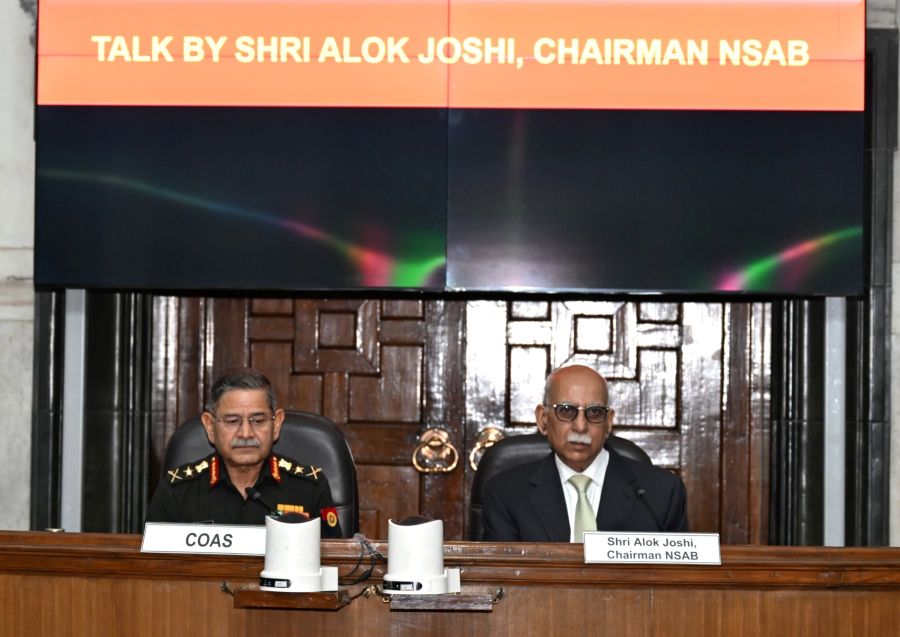
Alok Joshi, the Chairman of the National Security Advisory Board (NSAB), addressed senior leadership on Thursday, stressing the current state of global security, in which war and peace coexist. He emphasised the evolving geopolitical landscape, pointing out that areas such as energy, trade, and technology have become significant arenas of competition among nations. Joshi underscored the need for a comprehensive national strategy to safeguard the country’s interests across these critical sectors, ensuring resilience, stability, and growth.
There was also a broader consensus on the need to accelerate indigenous defence production to bolster long-term strategic resilience, particularly amid global supply chain disruptions.
Parallelly, the first edition of the biannual Naval Commanders’ Conference, held from April 14 to 17, focused on maritime security challenges amid rising geopolitical tensions, including the ongoing instability in West Asia.
In his address, Chief of the Naval Staff Dinesh K. Tripathi highlighted the increasingly contested maritime environment, shaped by overlapping conflicts, the erosion of a rules-based order and the growing threat from non-state actors.
He called for sustained combat readiness and faster adoption of emerging technologies to build a future-ready force, while reiterating the Navy’s responsibility in securing the Indian Ocean Region. He also stressed the importance of stronger engagement with friendly foreign countries through bilateral and multilateral exercises.
The conference included a comprehensive review of operational preparedness, logistics, infrastructure and human resource management. It also saw the release of the Indian Navy Maritime Security Strategy (INMSS) 2026, which outlines the Navy’s approach to safeguarding national interests in the maritime domain over the coming decade.
The strategy aligns with broader national frameworks such as Vision 2047 and reflects the changing character of warfare, including the growing role of disruptive technologies and the need for organisational reforms.
The Chief of Defence Staff, Anil Chauhan, interacting with naval commanders, flagged the shifting geopolitical order and urged the services to prepare for the expanding technological and economic dimensions of warfare.
Taken together, the twin conferences underscored a clear strategic direction: sharper jointness through theatre commands, rapid technological absorption, and a sustained push for self-reliance. The deliberations also reinforced the need for a whole-of-nation approach, bringing together the military, government and industry, to navigate an increasingly uncertain global security environment.
Team BharatShakti