Is the much-touted Make in India or atmanirbharta policy in defence in danger of being hijacked by firms that emphasise assembling foreign-designed products and passing them off as indigenous platforms? Recent instances of some hurried procurements and inductions in the Indian military seem to suggest so.
Post-Operation Sindoor, the armed forces noted some gaps in the capabilities required for a short, sharp conflict. Accordingly, they began scouting for platforms to address the deficiencies, despite some products failing to make the mark during last year’s war with Pakistan.
Provisions under the Emergency Procurement (EP), granted by the government, address immediate requirements and seemed to work fine for a couple of years, from 2022-23 until some well-connected firms started importing designs and ‘white labelling’ them as indigenously made platforms.
For instance, a recent EP procurement case has drawn heavy criticism from the Indian Army for showing undue haste.
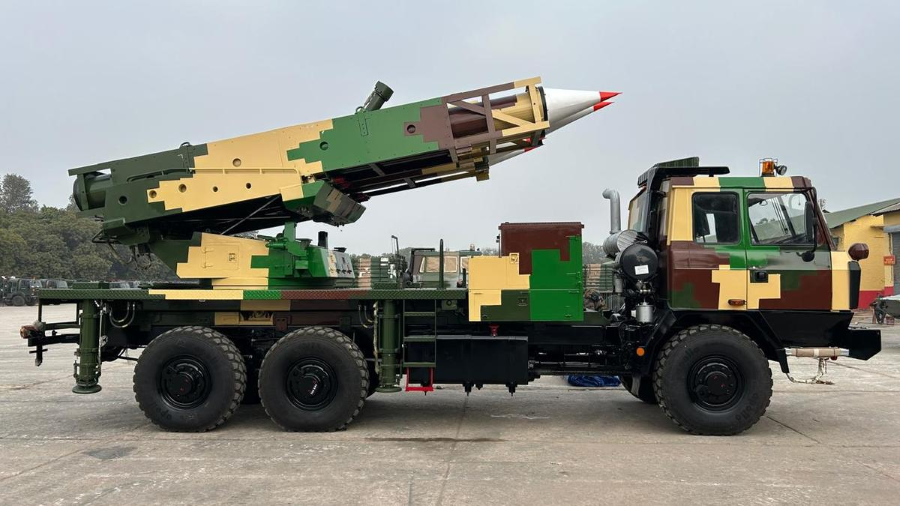
As Swarajya magazine reported: “On 23 May 2026, Defence Minister Rajnath Singh and the then Chief of Defence Staff General Anil Chauhan inaugurated the 200-acre Nibe Defence manufacturing complex at Shirdi. Pride of place at the event went to the Suryastra Universal Rocket Launcher, the platform for which the Indian Army has just signed an emergency procurement contract worth Rs 292.69 crore for long-range precision rockets at 150 and 300 kilometres.”
Touted as India’s first 300 KM Universal Rocket Launching System, the Suryastra multi-rocket system is nothing but a platform designed and manufactured by Elbit Systems of Israel, current and former military officials point out.
Speaking to BharatShakti, defence sources have flagged several aspects that point to what is derogatorily referred to as ‘screwdriver giri’ (meaning assembled only in India, with hardly any value addition to the imported platform). The technology, they say, is definitely not Indian.
What has further evoked surprise is the speed with which the platform has been delivered. As military officials point out, the entire process was completed in less than six months. The contract was apparently signed in January 2026. The flight test of the system was conducted at the Integrated Test Range (ITR), Chandipur, on 18-19 May by the DRDO, and the first lot of the rocket launchers was flagged off on 23 May, perhaps an Indian record for procurement! There is no information on whether user trials, which usually follow a DRDO-conducted test, were carried out by the Indian Army.
Now, less than a month later, sources say, in one of the four test flights carried out on 18-19 May, the missile (called Predator Hawk in Israel) broke into pieces in less than 15 km at a height of 7 km minutes after the launch, when its claimed range is in the vicinity of 300 km. Moreover, DRDO officials say they are not privy to the telemetry data from these tests, as they did not carry out the process. The question is: who was processing the data, then?
That and other troubling questions (what was the compulsion in procuring a basic system in such a great hurry, and if the cost of each rocket, said to be in the vicinity of Rs 14 crore, apart), it must be noted, of course, that this may not be the only case where the manufacturers have been economical with the truth.
The case also highlights the disincentivisation of other defence firms in India, which are willing to invest money and time in research and development to create their own IP for defence platforms.
There is also a risk in following this shortcut in inducting white-labelled goods into the military in the current, uncertain global environment. Just as the United States government ordered Anthropic to withdraw its most powerful artificial intelligence models, there is every possibility of a foreign OEM abruptly cutting off supply in crunch situations.
Anthropic, the AI company in the US, said last Friday it will “abruptly disable” its most advanced AI models for all users after the US government ordered it to suspend access to the models for foreign nationals, citing national security concerns. Even if the OEM is based in a friendly country, global disruptions may delay or deny access to spares or the full system.
As Brig NP Singh (Retd) wrote in a recent article in BharatShakti: “The future battlefield will not reward countries that merely manufacture platforms. It will reward those capable of building adaptive ecosystems. India’s long-term success will depend not on isolated procurement decisions, but on ecosystem building….”
As a founding member of the Army Design Bureau ecosystem, Brigadier Singh has been instrumental in building strategic partnerships between the Armed Forces, industry leaders, start-ups, academia, and research institutions, helping bridge operational military requirements with indigenous technological innovation and therefore knows what it takes to create products rather than just build to print.
It’s time India reviews its policies and procedures to truly implement atmanirbharta in defence, since India’s wars can be won not by imported platforms but by genuine India-made, India-manufactured products.
Team BharatShakti