



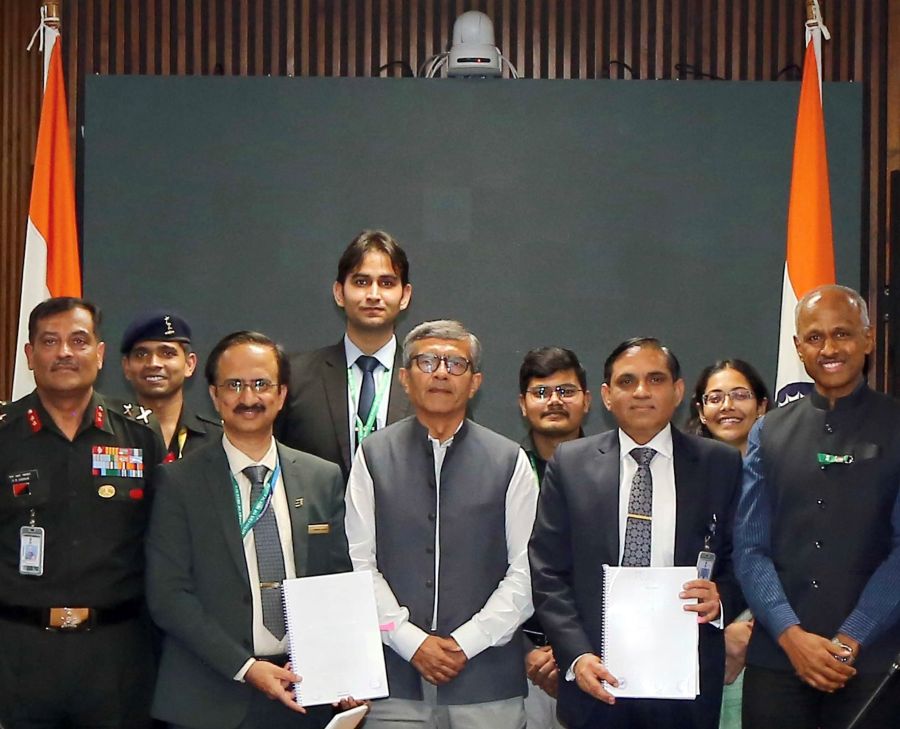
In a significant boost to its electronic warfare capabilities, the Indian Army will induct a new indigenous system designed to detect and track enemy radars, following the signing of a Rs 1,476-crore contract between the Defence Ministry and Bharat Electronics Limited (BEL).
The deal covers the procurement of five Ground-Based Mobile Electronic Systems (GBMES), developed by the Defence Electronics Research Laboratory (DLRL) in Hyderabad and manufactured by BEL. The programme falls under the ‘Buy (Indian–Indigenously Designed, Developed and Manufactured)’ category and carries at least 72 per cent indigenous content.
According to the Defence Ministry, the induction of GBMES will enhance battlefield awareness and strengthen domestic defence manufacturing. BEL, in a regulatory filing, described the system as a networked intelligence platform capable of detecting, classifying and locating a wide spectrum of radar emitters, while also intercepting and analysing communication signals.
Configured as an integrated electronic intelligence (ELINT) and electronic support measures (ESM) system, GBMES is designed to monitor the electromagnetic spectrum and identify radar signatures from aircraft, missile systems, air defence networks and other sensors. Using advanced receivers and direction-finding technology, it can accurately locate emitters across multiple frequency bands.
The system operates through a network of three receiving stations and a control station, with built-in redundancy to ensure operational continuity. A repeater link extends its range, improving coverage and survivability.
With features such as high sensitivity, precise direction-finding, and radar fingerprinting, GBMES is expected to act as a force multiplier, improving early warning, targeting support, and situational awareness on increasingly network-centric battlefields.
Team BharatShakti