



India and Belgium on Thursday moved to deepen defence-industrial cooperation, with Indian and Belgian companies signing multiple agreements to combine Belgian technology with India’s manufacturing capabilities for the joint development and production of defence systems.
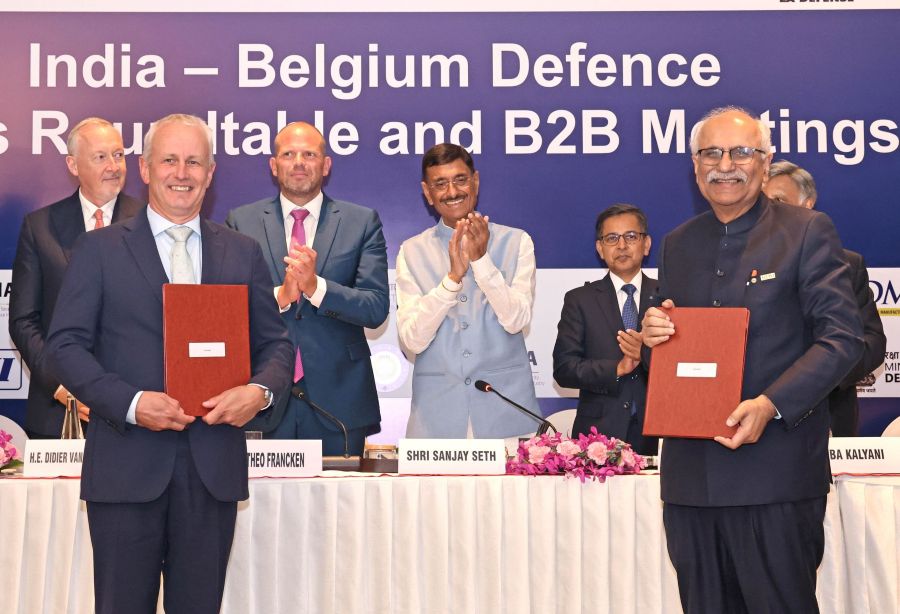
The agreements were exchanged at the India-Belgium Defence CEOs Roundtable and B2B meetings in New Delhi, attended by Belgian Defence and Foreign Trade Minister Theo Francken and India’s Minister of State for Defence Sanjay Seth. Representatives of Belgian defence companies, the Confederation of Indian Industry (CII) and the Society of Indian Defence Manufacturers (SIDM) participated in the meeting.
The pacts cover a range of areas and bring together major Indian defence companies and Belgian technology firms. They include agreements between SIDM and the Belgian Security & Defence Industry; Larsen & Toubro and Exail Robotics; Kalyani Strategic Systems and FN Herstal; Tembo Classic Engineering and Lachaussée; India Optel and OIP; Krishna Industries and Pitagone; DGVK Enterprises and Sol1; and Kalyani Strategic Systems, Thales Belgium and Thales India.
The agreements aim to create opportunities for technology collaboration, industrial partnerships, and the manufacture of niche defence products, with both sides emphasising co-development and co-production as the way forward.
Francken said there was considerable scope for deeper industrial cooperation between the two countries to strengthen their respective armed forces amid a rapidly evolving security environment. Highlighting the growing strategic partnership between India and the European Union, he pointed to expanding institutional dialogue in areas such as maritime security, information security and aerospace.
“United we stand, divided we fall,” Francken said, underscoring the need for greater cooperation between the two countries.
Seth, meanwhile, urged Belgian defence manufacturers to combine their technological expertise with India’s manufacturing scale to develop and produce niche capabilities. He identified cybersecurity, AI-enabled unmanned aerial systems, underwater domain vehicles, and complex weapon systems as potential areas for expanded cooperation.
He also pointed to India’s defence innovation ecosystem, including the iDEX and ADITI programmes, as avenues for joint research and industrialisation in areas such as artificial intelligence, quantum technologies, military communications, counter-drone systems and adaptive camouflage.
The industrial push came against the backdrop of a wider review of bilateral defence ties. Defence Minister Rajnath Singh held talks with Francken in New Delhi, with the two sides reviewing the full spectrum of defence and defence-industrial cooperation. They agreed to expand engagement through a dedicated defence cooperation dialogue, high-level visits, training and capacity building.
The ministers also discussed regional security and the need for greater maritime security cooperation in the Indo-Pacific, reaffirming that the India-Belgium partnership is founded on mutual trust and respect.
The talks took place alongside Prime Minister Narendra Modi’s meeting with Belgian Prime Minister Bart De Wever in New Delhi.
The latest industrial agreements come as India seeks to reduce dependence on defence imports while building an internationally competitive domestic defence manufacturing base. Seth said India’s defence sector is increasingly being driven by a combination of public-sector units, private companies and more than 16,000 MSMEs, with capabilities spanning aerospace, naval and land platforms, defence electronics, cyber and space technologies, and unmanned systems.
He stressed that India’s push for strategic autonomy is not aimed at limiting international partnerships, but at creating mutually beneficial collaborations involving technology transfer, co-development and manufacturing in India.
The government has allowed up to 74% foreign direct investment in defence through the automatic route and up to 100% through the government route in cases involving niche technologies. Defence Industrial Corridors in Tamil Nadu and Uttar Pradesh, along with planned corridors in other states, are also being positioned as platforms for foreign defence companies seeking to establish manufacturing and technology partnerships in India.
Team BharatShakti