



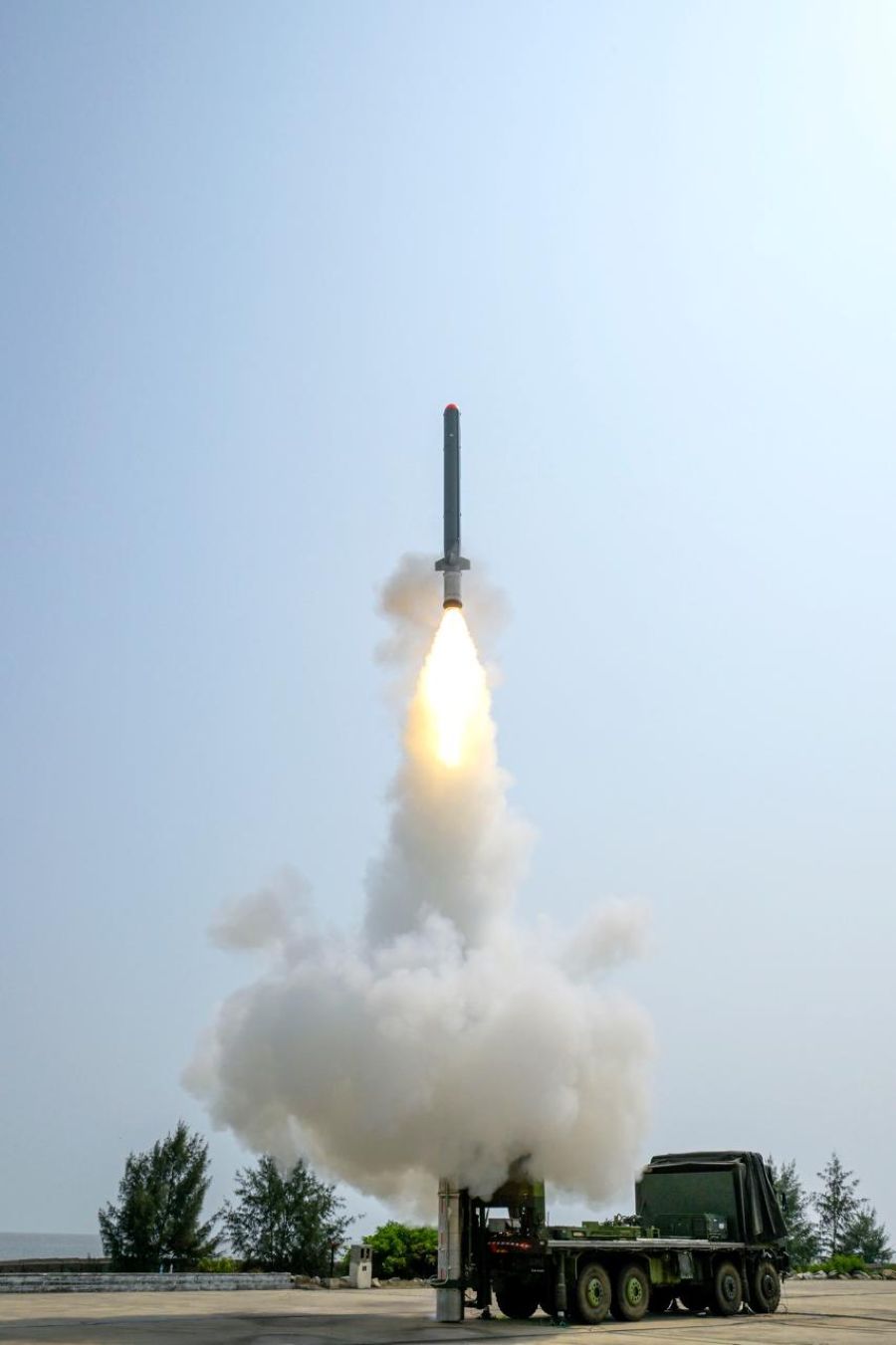
India on Monday successfully conducted the flight test of its indigenously developed Long Range Land Attack Cruise Missile (LRLACM), aiming to achieve the country’s long-range precision-strike capability.
The Defence Research and Development Organisation (DRDO) carried out the test from Dr APJ Abdul Kalam Island, off the Odisha coast. According to the Defence Ministry, all mission objectives were successfully achieved, with the missile’s performance validated by data from tracking systems deployed by the Integrated Test Range (ITR) at Chandipur.
The missile is being developed for induction across the armed forces and is expected to equip the Army, Navy and Air Force. Plans are also underway to integrate the weapon with the Indian Air Force’s frontline Su-30MKI fighter aircraft, significantly expanding its operational reach.
Developed under a high-priority Mission Mode Project, the LRLACM has been designed primarily by the Aeronautical Development Establishment (ADE), Bengaluru, the nodal DRDO laboratory for the programme. Several other DRDO laboratories and industry partners have contributed to the project, including public sector firms Bharat Dynamics Limited (BDL) and Bharat Electronics Limited (BEL).
The latest trial follows the missile’s maiden successful flight test conducted on November 12, 2024, from the Integrated Test Range in Odisha.
With a strike range estimated at 1,000-1,500 km, the LRLACM is intended to provide India with the capability to conduct deep-precision strikes against high-value land targets. The missile is capable of carrying either conventional or nuclear warheads, offering operational flexibility across a range of conflict scenarios.
Measuring about six metres in length and weighing nearly one tonne, the missile is an advanced derivative of the earlier Nirbhay cruise missile programme.
One of its defining features is its ability to fly at subsonic speeds while closely following the terrain, enabling it to evade enemy radar and air defence networks for much of its flight. Such terrain-hugging capability makes it particularly effective against heavily defended targets.
The missile has been designed for launch from multiple platforms. Besides being fired from a mobile ground-based articulated launcher, it can also be deployed from universal vertical launch modules aboard frontline naval warships. Future integration with the Su-30MKI will add an air-launched dimension to the system, giving the armed forces a versatile long-range strike option.
Defence planners view the LRLACM as a crucial addition to India’s missile arsenal, complementing the supersonic BrahMos cruise missile by offering a longer-range, subsonic capability tailored for sustained precision attacks.
The project has already received Acceptance of Necessity (AoN) from the Defence Acquisition Council for services procurement. Initial acquisition plans are estimated at around Rs 10,000 crore for the Indian Air Force and Rs 4,000 crore for the Indian Army, signalling the military’s confidence in the indigenous system.
Often compared with globally deployed cruise missiles such as the United States’ Tomahawk and Russia’s Kalibr, the LRLACM is expected to significantly enhance India’s strategic deterrence by providing a stealthy, accurate and cost-effective long-range strike capability.
Team BharatShakti