






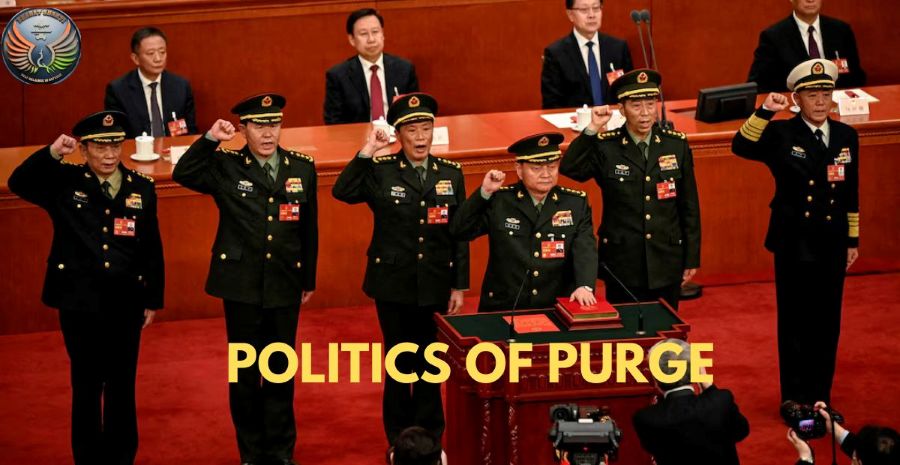
China’s latest round of purges has become one of the defining features of Xi Jinping’s rule. What Beijing projects as a relentless anti-corruption campaign increasingly appears to be something far broader, a systematic effort to tighten political control, eliminate uncertainty within the ruling elite and ensure that personal loyalty to Xi remains the foremost principle governing power. The scale of the crackdown is unprecedented. Reports indicate that since 2022, more than 100 senior military officers have either been removed, sidelined or disappeared from public view.
The most dramatic shake-up has unfolded at the top of the People’s Liberation Army (PLA). In January 2026, China’s Defence Ministry announced that Zhang Youxia and Liu Zhenli were under investigation for “serious disciplinary and legal violations”. The announcement sent shockwaves through strategic circles. Zhang, in particular, had long been regarded as one of Xi’s closest military associates, making his fall all the more significant.
The Politics of Purge
Officially, Beijing continues to frame these actions as part of its campaign against corruption, bribery and breaches of discipline. Corruption has unquestionably been a deep-rooted problem within China’s political and military establishment, especially where promotions, procurement and patronage intersect with political influence. Yet the sheer breadth and persistence of the campaign suggest that its objective extends well beyond punishing corruption. It is equally about reshaping the elite, dismantling entrenched power networks and removing anyone considered politically unreliable, overly ambitious or insufficiently loyal.
That is what gives the current purge its wider political significance. In authoritarian systems, anti-corruption drives rarely serve only judicial purposes; they also function as instruments of political management. They remove genuine offenders, but they also discipline rival factions, weaken alternative centres of influence and remind every official that political survival depends on proximity to the supreme leader.
Under Xi Jinping, this logic has become increasingly visible. The party-state’s message is clear: no rank, connection or record of service guarantees protection. That message may strengthen Xi’s authority in the immediate term, but it also breeds anxiety across both the political leadership and the military establishment.
Purge, Power and the PLA
The military dimension of the purge is particularly significant. The PLA is not simply China’s armed forces – it is the armed wing of the Chinese Communist Party and the principal guarantor of regime security. Consequently, the removal of senior commanders has implications that extend far beyond individual careers. It affects continuity of command, institutional trust and the overall functioning of the military hierarchy.
Recent reports suggest that the campaign has already hollowed out sections of the PLA’s top leadership. Reuters reported that China’s Central Military Commission, once comprising seven members, had effectively been reduced to just two active figures – Xi Jinping and newly appointed Vice Chairman Zhang Shengmin. Other reports describe a recurring pattern of generals and lieutenant generals being dismissed, investigated, or quietly disappearing from public view, leaving considerable uncertainty over the actual state of China’s military leadership.
That uncertainty carries strategic consequences. A military constantly under political scrutiny may remain outwardly disciplined, but it is unlikely to be institutionally confident. Senior officers become reluctant to speak candidly and honestly, while commanders lower down the chain increasingly focus on avoiding political risks rather than improving operational readiness. For a force preparing for complex, high-intensity contingencies, such a state carries obvious risks.
Politics of Corruption and Loyalty
There is little doubt that corruption has been a serious issue within the PLA. The 2026 sentencing of suspended death sentences for bribery for both former Defence Ministers Li Shangfu and Wei Fenghe underscores the seriousness with which Beijing views the problem. Yet these prosecutions also fit a broader political pattern. They demonstrate that even figures once considered untouchable can be sacrificed when political expediency demands it.
For Xi Jinping, this serves two purposes. It projects an image of uncompromising discipline while reinforcing the principle that the Party stands above all personal loyalties, even those cultivated under Xi’s own leadership.
But therein lies the paradox. The more aggressively the leadership purges its own institutions, the greater the risk of creating a culture dominated by caution, concealment and self-preservation. Such an atmosphere inevitably weakens governance. Officials fearful of investigation become less willing to take initiative. Subordinates conceal problems until they become crises. Information moving up the chain becomes increasingly filtered as everyone tries to anticipate what leadership wants to hear rather than what it needs to know.
Purges may preserve political control, but they can quietly erode institutional competence.
Strategic Costs of Absolute Control
The most immediate strategic concern is military readiness. Several external assessments suggest that the continuing purge has affected command efficiency and could slow the PLA’s rapid modernisation programme. It does not imply that China is becoming militarily weak. It remains a major military power with vast resources, sophisticated capabilities and an exceptionally centralised mobilisation system.
Nevertheless, sustained political turbulence inevitably imposes costs. Even powerful armed forces are not immune to the effects of uncertainty at the top.
There is also a broader reputational cost. A state that repeatedly removes top military leaders without transparent explanation creates uncertainty not only among its own citizens but also among foreign governments and strategic planners. Foreign observers are left to speculate whether each purge reflects corruption, factional rivalry, professional incompetence or deeper political insecurity.
That ambiguity increasingly shapes China’s international image – powerful and disciplined, yet opaque and internally unsettled.
What the Purges Reveal
The deeper lesson of the purges is not merely that Xi Jinping continues to consolidate power. His model reveals that it depends heavily on fear as an instrument of control. Purges undoubtedly project authority, but they also expose underlying insecurity. A confident political system does not need to remove so many of its own senior officials so repeatedly, often without warning and with little public explanation.
In that sense, the campaign tells us as much about the pressures inside
The campaign reveals as much about the pressures within China’s political system as it does about Xi’s authority. It reflects a leadership determined to prevent fragmentation, enforce conformity and eliminate ambiguity. Yet it also highlights the costs of governing through distrust. When loyalty becomes the overriding criterion, institutions may become more compliant, but they do not necessarily become more capable.
Conclusion
China’s ongoing purges are therefore far more than an internal Communist Party affair. They provide an important window into the evolving character of power under Xi Jinping – highly centralised, increasingly personalised, and reliant on political cleansing as an instrument of governance.
The immediate outcome is tighter control over both the Party and the military. The longer-term consequence, however, may be the emergence of institutions that are unquestionably more obedient, but potentially less resilient, less adaptive and ultimately less effective in dealing with the strategic challenges China seeks to confront.
Ravi Shankar

Dr Ravi Shankar has over two decades of experience in communications, print journalism, electronic media, documentary film making and new media.
He makes regular appearances on national television news channels as a commentator and analyst on current and political affairs. Apart from being an acknowledged Journalist, he has been a passionate newsroom manager bringing a wide range of journalistic experience from past associations with India’s leading media conglomerates (Times of India group and India Today group) and had led global news-gathering operations at world’s biggest multimedia news agency- ANI-Reuters. He has covered Parliament extensively over the past several years. Widely traveled, he has covered several summits as part of media delegation accompanying the Indian President, Vice President, Prime Minister, External Affairs Minister and Finance Minister across Asia, Africa and Europe.