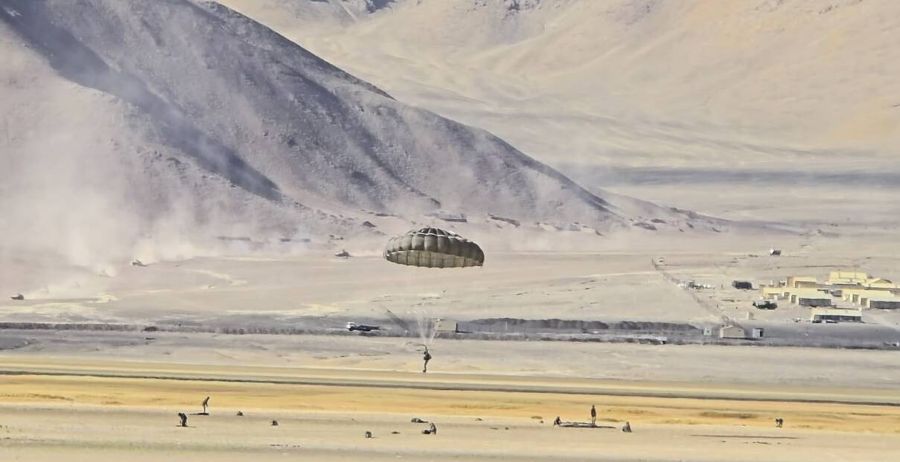
India has demonstrated a new indigenous capability for deploying paratroopers in extreme high-altitude terrain, with the Defence Research and Development Organisation (DRDO) conducting the maiden live jump of its Advanced High-Altitude Parachute (AHAP) at Nyoma in eastern Ladakh.
The live jump, conducted from 16,000 feet above mean sea level, is significant because airborne operations at such altitudes present a far greater challenge than conventional parachute jumps. The AHAP was deployed at 15,500 feet and the paratrooper landed at the Nyoma (Mudh) drop zone at about 13,700 feet.
For India’s armed forces, the capability has particular relevance to the high-altitude operational environment along the northern borders, where terrain, altitude and weather can severely restrict conventional movement and reinforcement.
The AHAP has been designed as a static-line parachute system for mass deployment of paratroopers, with an operational altitude range extending up to 18,000 feet. DRDO says the system offers multiple deployment modes and a rate of descent suited to the tactical requirements of the armed forces in high-altitude areas.
High-altitude static-line jumps are inherently more demanding. Reduced atmospheric density can affect parachute deployment and descent, while the opening shock and descent characteristics pose additional risks to the paratrooper. Demonstrating the system in a live jump at Nyoma therefore represents a more significant milestone than a laboratory or conventional-altitude trial.
The parachute has been developed by the Aerial Delivery Research and Development Establishment (ADRDE), Agra, and manufactured by the Ordnance Parachute Factory (OPF), Kanpur. It has been inspected by the Directorate General of Aeronautical Quality Assurance (DGAQA) and certified by the Centre for Military Airworthiness and Certification (CEMILAC), RCMA Kanpur.
The development also reflects the growing emphasis on building specialised equipment domestically for India’s military requirements, particularly capabilities tailored to the country’s unique geography and operational environment.
The significance of the AHAP goes beyond the parachute itself. The ability to insert troops into high-altitude areas by air provides commanders another option for rapidly reinforcing or occupying tactically important locations that may be difficult to access by road or conventional ground movement.
However, the operational utility of such a system will ultimately depend on its integration with the broader airborne warfare architecture, including suitable transport aircraft, trained airborne forces, navigation and precision drop capabilities, and the ability to sustain troops after insertion.
Defence Minister Rajnath Singh congratulated DRDO, the armed forces, defence PSUs and industry on the successful maiden live jump, calling it another step towards Aatmanirbhar Bharat.
The Nyoma demonstration thus marks an important step in India’s effort to develop an indigenous high-altitude airborne capability, one that could assume greater importance as the military prepares for sustained operations in some of the world’s most demanding terrain.
Team BharatShakti