





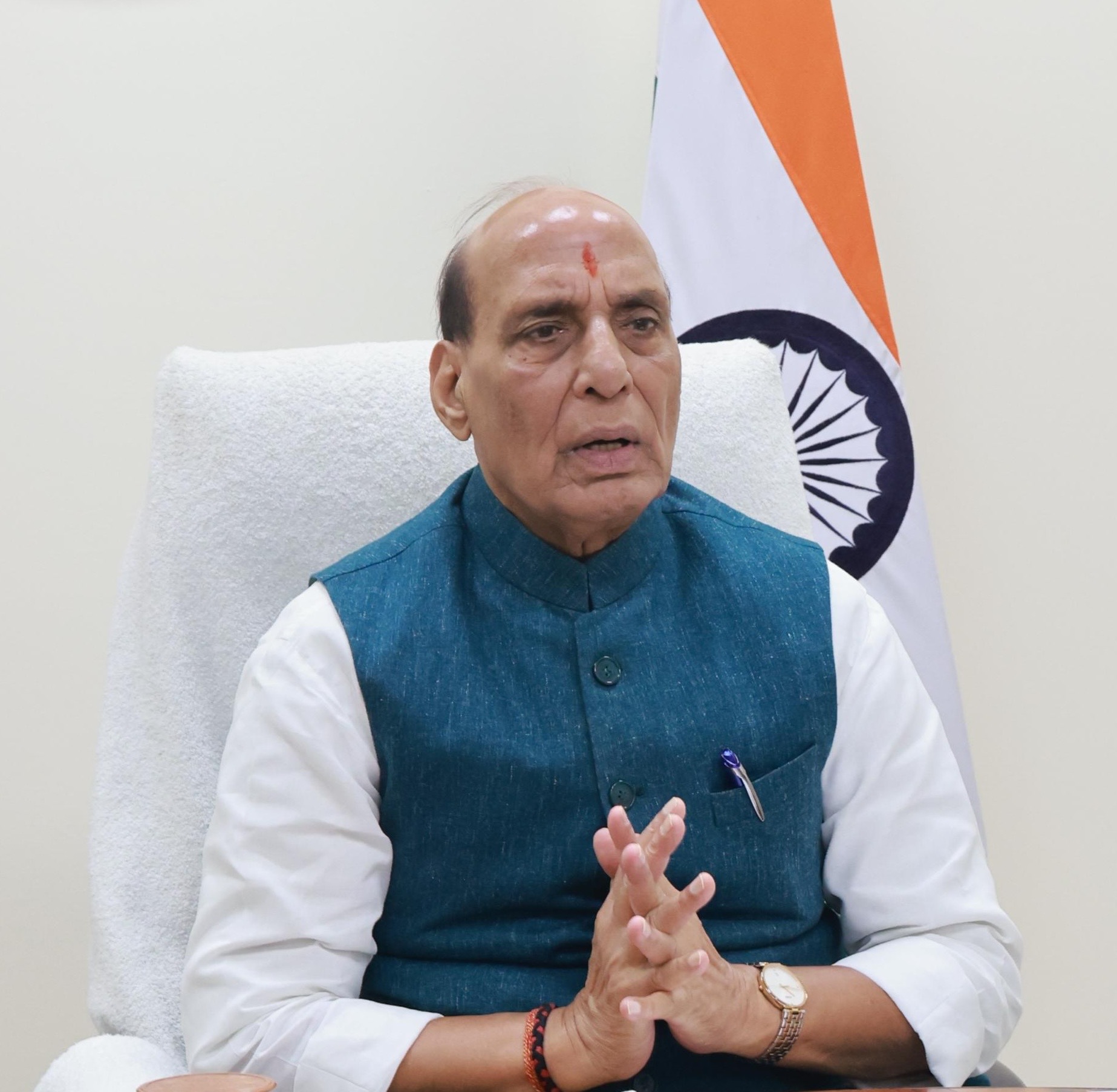
Defence Minister Rajnath Singh has called for developing indigenous capabilities in advanced Non-Destructive Testing (NDT) technologies, asserting that technological self-reliance is a strategic necessity for India’s defence preparedness and national security.
Addressing the 36th Annual Conference on Non-Destructive Evaluation & Enabling Technologies and the 15th International Symposium on Non-Destructive Testing in Aerospace virtually on November 15, Singh said India must move beyond being a user of advanced technologies to becoming their developer, innovator and global leader.
He stressed that reliable inspection technologies, rigorous quality assurance and accurate testing results were indispensable to ensuring the safety, performance and operational reliability of defence platforms. “There can be no compromise on the integrity of testing results in strategic applications,” he said.
Singh called for indigenous development of advanced inspection technologies, specialised sensors, evaluation equipment and software to reduce technological dependence and secure critical defence supply chains. He urged public sector undertakings, private manufacturers, start-ups and MSMEs to adopt consistent quality standards and ensure that inspection results are accurate, reliable and traceable.
Highlighting the operational significance of NDT, the Defence Minister said hidden defects in materials and components could compromise equipment availability, increase maintenance costs, shorten service life and, in critical situations, jeopardise mission success. He advocated shifting from merely detecting defects to preventing them by embedding quality assurance throughout the manufacturing process.
With defence systems becoming increasingly sophisticated, Singh said quality was no longer merely a manufacturing requirement but an essential component of operational reliability and national security, particularly in missiles, aircraft, naval platforms and spacecraft.
Citing indigenous achievements in missile development, aerospace engineering, naval platforms, radar systems and space applications, he said India’s expanding defence industrial capabilities reflected the progress of Atmanirbharta. The commissioning of the country’s first indigenous aircraft carrier, INS Vikrant, was an important milestone in this journey.
Singh also highlighted the role of Innovations for Defence Excellence (iDEX) and the Technology Development Fund (TDF) in promoting innovation, experimentation and indigenous technology development.
On emerging technologies, he said Artificial Intelligence, Machine Learning, robotics, advanced sensors, digital twins and predictive analytics were transforming inspection and structural health monitoring by improving accuracy, efficiency and the ability to identify defects.
Calling for their intelligent integration with conventional inspection techniques, Singh urged Indian researchers and industry to develop indigenous solutions tailored to strategic requirements and capable of competing in international markets.
He emphasised stronger collaboration among government, industry, academia and research laboratories to accelerate technological advancement and strengthen India’s defence self-reliance.
“Atmanirbharta in defence is not merely an economic objective but also a strategic necessity,” he said.
Team BharatShakti