






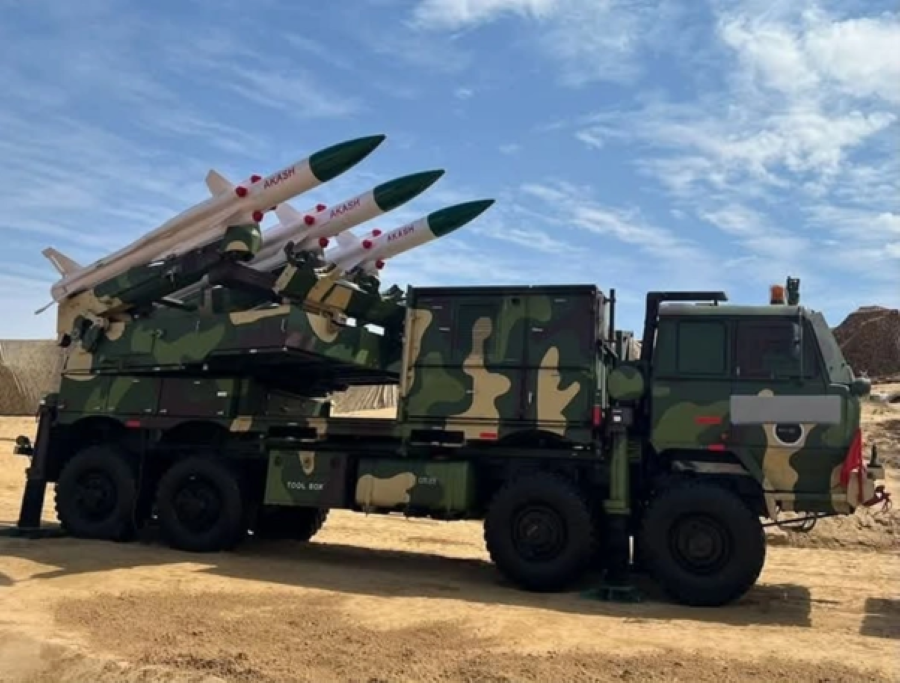
India’s Akash air defence missile system has secured customers in three Central Asian countries – Armenia, Tajikistan and Turkmenistan – strengthening the system’s position as one of the country’s most significant indigenous defence export successes.
Defence Secretary Rajesh Kumar Singh said Akash production has stabilised, with orders continuing from the Indian Armed Forces even as exports expand.
“Armenia was the first customer, which has taken multiple batteries. Thereafter, we’ve also exported it to Tajikistan and Turkmenistan. Production has stabilised. We have additional orders for our own services, and I’m sure there will be many more from various parts of the world,” Singh told ANI in an exclusive interaction.
The disclosure is significant for India’s defence export ambitions. Akash is not merely an export of individual missiles but represents a larger indigenous air-defence system involving launchers, radars, command-and-control elements and associated support infrastructure.
Singh described Akash as a key example of the growing maturity of India’s domestic missile design and production ecosystem.
“Akash, I would say that it is one of our success stories. It shows the maturing of our indigenous missile design and production system. It is effective in dealing with high-velocity aerial targets,” he said.
Developed by the Defence Research and Development Organisation (DRDO), Akash has evolved from an Indian military programme into an exportable air-defence product. Bharat Dynamics Limited (BDL) is the system’s missile manufacturer, while Bharat Electronics Limited (BEL) is involved in its electronics and associated systems.
The original Akash system has an engagement range of around 25–30 km, while the newer Akash-NG is designed for longer-range engagements, with an intended range of up to 50 km.
The system’s export journey also comes at a time when air defence has assumed greater importance globally, with conflicts demonstrating the growing threat from aircraft, cruise missiles, drones and other aerial targets.
For India, the challenge now is to convert individual export successes into sustained international orders. The fact that Akash is already being operated by foreign customers provides an important reference point for future marketing of the system and its newer variants.
Akash is part of a wider effort by New Delhi to move Indian defence exports beyond a limited number of platforms and ammunition categories. The government has been seeking to leverage India’s expanding domestic defence-industrial base, competitive costs and growing manufacturing capacity to establish a larger presence in overseas markets.
Singh had earlier identified cost competitiveness as one of India’s principal advantages in the global defence market. The Ministry of Defence is targeting defence exports of Rs 50,000 crore over the next two years.
At the 13th PAFI Annual Forum 2026 panel discussion on Building India’s Competitive Advantage, Singh also cited the BrahMos supersonic cruise missile as one of India’s best-known defence export products.
The Akash export story, however, offers a different proposition – an indigenous, layered air-defence system that has been developed, inducted and produced at scale for the Indian Armed Forces and is now finding overseas customers.
With production stabilised and domestic orders continuing, the next test will be whether India can turn the three-country Akash footprint into a much larger export market, particularly for newer variants such as Akash-NG.
Team BharatShakti