


India and Israel are entering a new phase in their defence relationship, moving beyond three decades of arms sales towards joint development, technology sharing and co-production as both countries seek to navigate an increasingly volatile geopolitical landscape.
“The India-Israel relationship is shifting to a more substantial phase where the buyer-seller relationship of the last three decades has given confidence for joint production of drones and co-development of space technology,” says Prof. Khinvraj Jangid, Visiting Faculty at Ben-Gurion University, Tel Aviv and head of Israel Studies at Jindal Global University.
“The two nations trust each other amidst growing anxieties of military power maximisation. They have historical appreciation, mutual trust and shared interests.”
Jangid believes the strategic convergence has sharpened after the recent Iran conflict.
“Post-Iran episode, India came out of its reluctance and favoured Israel and the Gulf nations. It is partially a political and ideological alignment and partially driven by hard national interests,” he says, adding that India could eventually emerge as a manufacturing partner for Israel, a role largely performed by the United States until now.
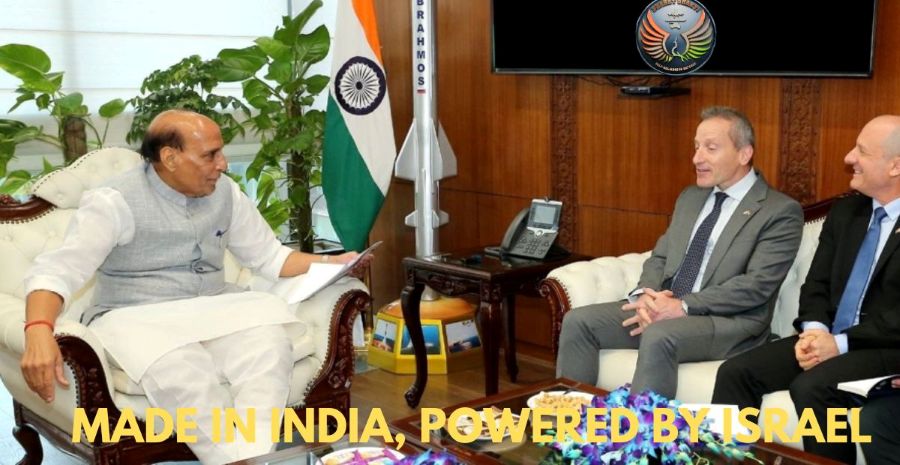
The changing trajectory was evident during the June 22 visit of Amir Baram, Chief of Staff of the Israeli Ministry of Defence (IMoD), who met Defence Minister Rajnath Singh and Defence Secretary Rajesh Kumar Singh in New Delhi. The discussions centred on advanced technology sharing, joint development of military systems and deeper industrial collaboration under the Special Strategic Partnership.
The visit builds on a memorandum of understanding signed earlier this year, which identified artificial intelligence, cybersecurity, scientific research, industrial cooperation, and the co-development of advanced military technologies as key pillars of future engagement.
Unlike most global defence exporters, which specialise in complete weapon platforms, Israel has built its reputation around niche technologies – radars, seekers, sensors, electronic warfare suites, precision-guidance systems, drones, and battlefield networking. These technologies can be integrated into a wide range of existing platforms, making them particularly attractive to India, whose armed forces operate Russian, Western and indigenous equipment simultaneously.
Prem Mahadevan, the Switzerland-based security researcher and author of ‘Spies Among the Sands: Assessing Seven Decades of the Mossad and Israeli National Security,’ published in 2024, says the partnership fits squarely into India’s long-term strategy of reducing dependence on any single supplier.
“India’s defence diversification is aimed not only at reducing dependence on Russia but also at accessing cutting-edge technologies that others are reluctant to share,” he says.
“Israel produces niche technologies compatible with a range of weapons platforms. That gives India flexibility instead of locking it into complete foreign weapon systems.”
Mahadevan argues that the relationship is increasingly becoming mutually beneficial. Israel possesses world-class defence technologies but limited manufacturing scale, while India offers production capacity, skilled manpower and a rapidly expanding defence industrial ecosystem.
“India can serve as a mass-manufacturing base for Israeli weapons, making them more affordable while simultaneously raising human capital in India’s defence industry through technology transfer and training,” he says.
This transition is already visible.
Missile cooperation illustrates how the relationship has evolved. What began with the induction of the Barak-1 naval air-defence missile has matured into the jointly developed Barak-8 programme, now deployed by the Navy, Air Force and Army as part of India’s layered air-defence architecture. Israeli SPYDER air-defence systems, Derby beyond-visual-range missiles and Rafael’s SPICE precision-guidance kits have similarly expanded India’s precision-strike capabilities, with several reportedly featuring during Operation Sindoor.
The partnership has been equally significant in unmanned systems. Heron and Searcher drones have provided surveillance along the borders with Pakistan and China for nearly three decades, while the induction of the Harop loitering munition marked India’s shift from intelligence gathering to precision stand-off strikes and suppression of enemy air defences.
Israeli technology is also deeply embedded in India’s surveillance architecture. The Air Force’s Phalcon airborne early warning aircraft, equipped with Israeli AESA radars, link fighters, ground radars and air-defence assets into an integrated network. Israeli electro-optical sensors, thermal imagers, electronic warfare systems and border surveillance technologies have become integral to India’s operational infrastructure.
The next phase, however, is increasingly centred on manufacturing in India. Joint ventures such as Adani Defence’s partnership with Elbit Systems to produce the Hermes 900-based Drishti-10 Starliner UAV in Hyderabad, and PLR Systems’ manufacture of Negev NG-7 light machine guns in Madhya Pradesh, signal a transition from licensed assembly to industrial collaboration.
Former National Security Advisory Board member Anshuman Tripathi believes the strategic environment is driving this acceleration.
“Defence ties are deepening because the geopolitical scenario is becoming more dynamic and warfare is increasingly precision-centric,” he says. India’s growing defence technology ecosystem, he adds, also provides New Delhi greater leverage during negotiations. “Indian leadership can leverage the lessons learnt from its own defence-tech ecosystem to negotiate better with Israel, whose industry faces many of the same commercial and technological challenges.”
For India, the roadmap extends well beyond filling capability gaps. As Mahadevan notes, the objective is to enhance capability in areas such as air defence, missile defence, cyber security, and artificial intelligence, while strengthening the country’s long-term goal of defence self-reliance.
Baram’s visit, therefore, marks more than another high-level exchange. It reflects a strategic convergence in which Israel offers niche technologies, and India provides scale, manufacturing capacity and a growing defence industrial ecosystem. Together, the two countries are seeking to build a partnership that is measured not merely by arms sales, but by jointly developed capabilities manufactured in India for its armed forces and, potentially, for export markets.
Ravi Shankar

Dr Ravi Shankar has over two decades of experience in communications, print journalism, electronic media, documentary film making and new media.
He makes regular appearances on national television news channels as a commentator and analyst on current and political affairs. Apart from being an acknowledged Journalist, he has been a passionate newsroom manager bringing a wide range of journalistic experience from past associations with India’s leading media conglomerates (Times of India group and India Today group) and had led global news-gathering operations at world’s biggest multimedia news agency- ANI-Reuters. He has covered Parliament extensively over the past several years. Widely traveled, he has covered several summits as part of media delegation accompanying the Indian President, Vice President, Prime Minister, External Affairs Minister and Finance Minister across Asia, Africa and Europe.