


China’s latest push to shape the global rules governing artificial intelligence is about far more than technology. It is about influence.
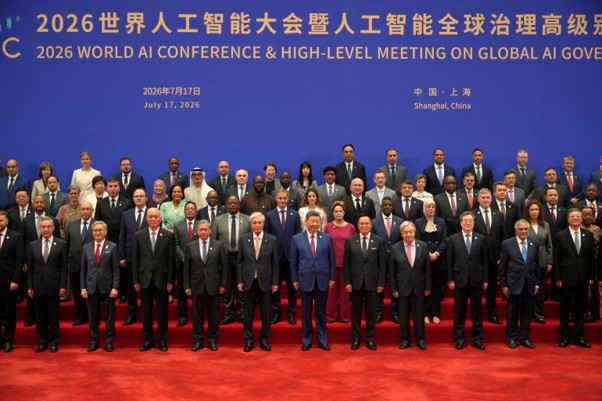
The World AI Conference (WAIC) in Shanghai this year marked a turning point. For the first time since the event began in 2018, Chinese President Xi Jinping personally addressed the gathering. Simultaneously, Beijing operationalised the World AI Cooperation Organisation (WAICO), a China-headquartered body backed by 29 countries, including Pakistan and Russia.
The twin developments underline China’s ambition to become not just an AI powerhouse but also the architect of global AI governance.
For India, however, the bigger question is whether a China-led governance framework can ever be viewed as neutral.
Pranay Kotasthane, who chairs the High-Tech Geopolitics Programme at Takshashila Institution, says the Shanghai conference itself reflects China’s steadily expanding geopolitical ambitions.
“The conference has entered a geopolitically charged era,” he says. “American participation has steadily reduced while China has increasingly used the platform to articulate its AI ambitions. Xi Jinping’s address made that trajectory explicit.”
According to him, the real significance lies not merely in Xi’s speech but in the launch of WAICO.
“You can think of it as the Belt and Road Initiative for AI,” Kotasthane says. “It is created by China, headquartered in China and brings together many countries already within China’s strategic ecosystem.”
That comparison is significant.
Just as the Belt and Road Initiative sought to expand Beijing’s economic and geopolitical footprint through infrastructure financing, WAICO seeks to shape the institutional architecture governing AI.
China’s timing is hardly accidental.
Its open-source AI models have rapidly narrowed the technological gap with American firms while remaining significantly cheaper. That gives Beijing greater credibility when presenting itself as an alternative technology provider for developing countries.
“Chinese models are available at a fraction of the cost of American proprietary models, and they are not very far behind frontier systems,” Kotasthane says. “That gives added weight to China’s messaging that it wants to be seen as a reliable provider of AI.”
Xi has simultaneously criticised what he called the West’s tendency to “overstretch” national security concerns in AI.
There is some truth to that argument.
The United States has increasingly tightened export controls, chip restrictions and AI diffusion rules to preserve its technological edge.
“National security rhetoric is naturally stronger in the US because that is where its technological advantage lies,” Kotasthane observes. “Countries always play to their strengths in strategic competition.”
But he cautions against accepting Beijing’s openness narrative at face value.
“China itself has imposed stringent restrictions in sectors like rare earths. It has introduced new decrees making overseas investments difficult and justified them on national security grounds,” he says. “That is classic hypocrisy in international relations.”
He expects similar behaviour once China achieves clear technological dominance in AI.
“Right now China is catching up, so openness suits its strategy. But once AI becomes critical public infrastructure, I would not be surprised if it adopts restrictions similar to those it has imposed in other sectors.”
That assessment explains why India has deliberately stayed outside WAICO.
New Delhi is pursuing what officials increasingly describe as a strategy of technological multipolarity, avoiding dependence on either Washington or Beijing.
“India’s AI strategy is to remain multipolar,” Kotasthane says. “The objective is to retain the option of working with multiple AI models, chips and trusted technology ecosystems rather than becoming dependent on any single bloc.”
He points to India’s participation in trusted technology initiatives such as the US-backed Partnership for AI and the Pax Silica ecosystem, which seeks to build secure supply chains and trusted partnerships across the AI stack.
For India, therefore, the challenge extends beyond deciding whether to join or boycott a Chinese-led institution.
The real contest is over who writes the rules governing AI in the coming decades.
Beijing is attempting to position itself as the champion of affordable AI and the Global South, while Washington is relying on technological leadership and national security controls.
Neither model fully serves India’s long-term interests.
The lesson for New Delhi is that strategic autonomy cannot mean remaining absent from global rule-making. If China is building institutions and the West is tightening technology alliances, India must become a rule-maker rather than merely a rule-taker.
The contest over AI is no longer confined to chips or algorithms.
It has entered the arena of global governance.
And that may ultimately determine who shapes the world’s digital future.
Ravi Shankar

Dr Ravi Shankar has over two decades of experience in communications, print journalism, electronic media, documentary film making and new media.
He makes regular appearances on national television news channels as a commentator and analyst on current and political affairs. Apart from being an acknowledged Journalist, he has been a passionate newsroom manager bringing a wide range of journalistic experience from past associations with India’s leading media conglomerates (Times of India group and India Today group) and had led global news-gathering operations at world’s biggest multimedia news agency- ANI-Reuters. He has covered Parliament extensively over the past several years. Widely traveled, he has covered several summits as part of media delegation accompanying the Indian President, Vice President, Prime Minister, External Affairs Minister and Finance Minister across Asia, Africa and Europe.