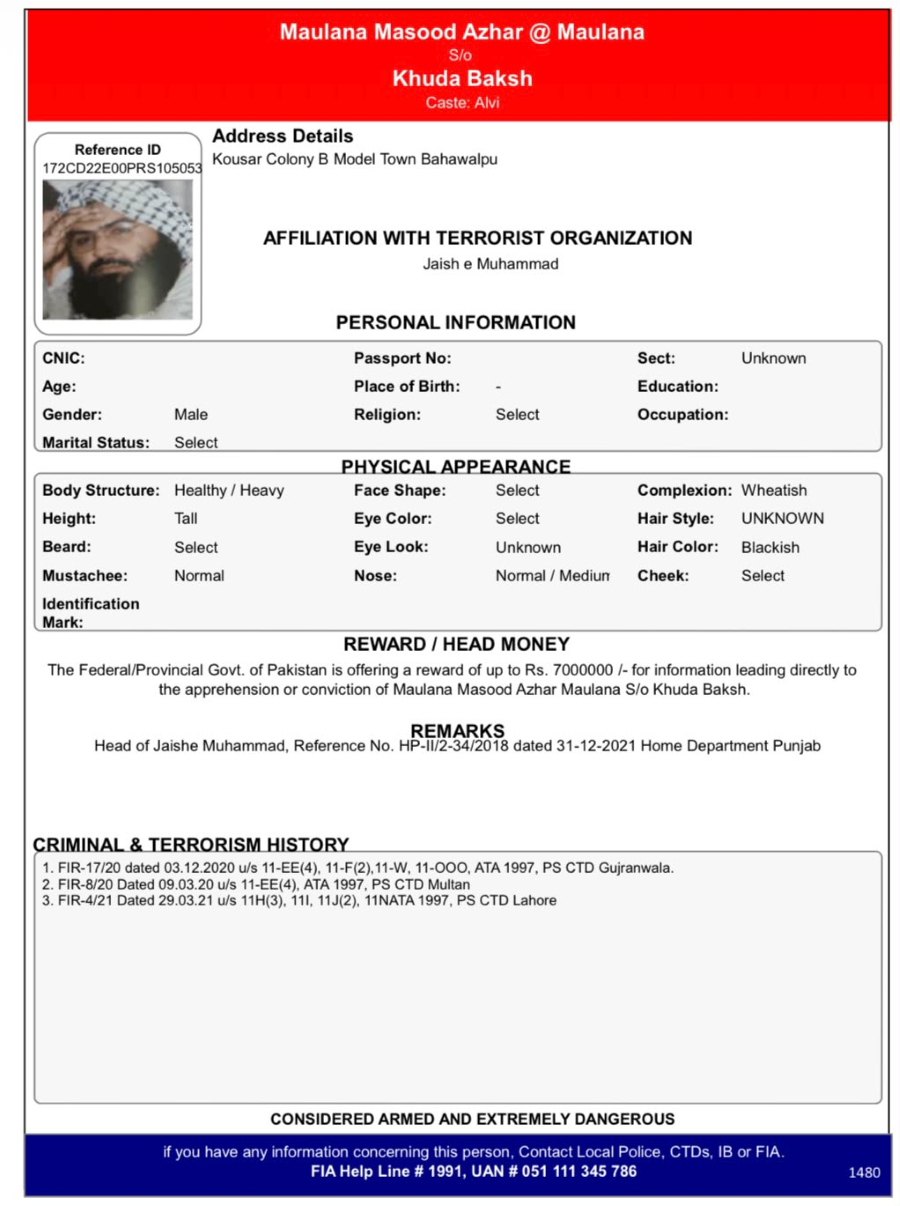
Pakistan has once again sought to project itself as taking action against terrorism, with its Federal Investigation Agency (FIA) raising the bounty on Jaish-e-Mohammed (JeM) Chief Masood Azhar to PKR 70 lakh and listing him as a fugitive in its latest Red Book of most wanted terrorists.
The timing is significant. The move comes ahead of the Financial Action Task Force (FATF) plenary in October, providing Islamabad an opportunity to showcase a fresh paper trail of action against terror suspects even as questions persist over whether those listed are actually being pursued.
Azhar’s case is particularly telling. Pakistan first began claiming in 2021 that the JeM chief was no longer in the country and had escaped to Afghanistan. The FIA had then announced a PKR 50 lakh reward for information leading to his arrest. Five years later, the bounty has been increased to PKR 70 lakh, but there has been no credible evidence that Pakistan has located or arrested him.
Indian intelligence assessments, based on technical inputs gathered over the past six months, indicate that Azhar is in fact hiding in Nawabshah in Sindh province. If that assessment is correct, Pakistan’s repeated claim that he is in Afghanistan raises fresh questions over whether Islamabad is deliberately creating distance between itself and one of the world’s most wanted jihadist leaders.
26/11 perpetrators still on the books
The FIA’s latest Red Book also exposes another glaring contradiction in Pakistan’s counter-terrorism narrative.
Seventeen individuals linked to the 26/11 Mumbai attacks continue to be listed as absconders. Their inclusion may suggest that Pakistan is pursuing those responsible for facilitating the 2008 attacks, but their continued presence on a wanted list after 18 years raises a more basic question: what has Pakistan actually done to bring them to justice?
The FIA’s own records identify the men as having assisted the Lashkar-e-Taiba (LeT) operation, including by arranging boats, providing logistical support and financing the attack.
More significantly, the latest version of the Red Book appears to have quietly diluted the information available on two of the suspects. The photographs, LeT affiliations and detailed operational roles of Muhammad Khan of Turbat and Abdul Rehman of Bahawalnagar, which appeared in the 2021 FIA list, have reportedly been removed. Their names remain, but critical identifying and contextual information has disappeared.
The remaining list identifies 11 LeT operatives who allegedly facilitated the maritime movement of the Mumbai attackers aboard Al-Hussaini and Al-Fauz. They include Muhammad Amjad Khan, Shahid Gafoor, Mohammad Usman, Ateeq-ur-Rehman, Riaz Ahmad, Muhammad Mushtaq, Muhammad Naeem, Abdul Shakoor, Muhammad Sabir Salfi, Muhammad Usman and Shakeel Ahmed.
Six other suspects are identified for providing financial or communications support for the operation. These include Muhammad Iftikhar Ali, who allegedly spent PKR 70,000 on the Voice over Internet Protocol (VoIP) communications used by the attackers and their handlers; Mohammad Zia, who allegedly provided PKR 80,000; Mohammad Abbas Nasir, PKR 2.53 lakh; Javed Iqbal, PKR 1.86 lakh; Mukhtar Ahmad, PKR 2.98 lakh; and Ahmed Saeed, who allegedly provided PKR 21 lakh.
A rising list, not rising accountability
The broader numbers tell another story. The FIA’s Red Book has expanded sharply since 2021, from 1,330 most-wanted terrorists to 1,804 in the latest edition – an increase of about 35 per cent.
Yet adding names to a wanted list is not the same as dismantling terrorist networks, prosecuting their operatives or securing convictions.
That distinction is central to Pakistan’s latest effort.
By publicly listing Masood Azhar, raising his bounty and retaining 26/11-linked suspects on its most-wanted roster, Islamabad can point to formal action when facing international scrutiny. But if the individuals remain beyond the reach of Pakistani law-enforcement agencies year after year, the Red Book risks becoming less a record of enforcement than a catalogue of unresolved cases.
The pattern is familiar: announce, list and claim pursuit – without demonstrating arrest, prosecution or conviction.
For international watchdogs, the real test therefore cannot be how many terrorists Pakistan puts on paper. It has to be whether those names translate into arrests, prosecutions and dismantling of the organisations and networks behind them.
In the case of Masood Azhar and the 26/11 suspects, that test remains conspicuously unmet.
Team Bharatshakti