


The Indian Air Force has ruled out creating a separate drone force, arguing that unmanned systems and loitering munitions must be integrated with conventional weapons and platforms. The position comes at a time when the United States is moving in the opposite organisational direction – creating a dedicated four-star Autonomous Warfare Command to accelerate the development and employment of drones, robotics and artificial intelligence across its armed forces.
The contrast raises a larger question for India’s military – as drones move from being supporting systems to becoming central to the way wars are fought, is integration within existing service structures enough, or does India also need a dedicated institutional mechanism to drive drone warfare?
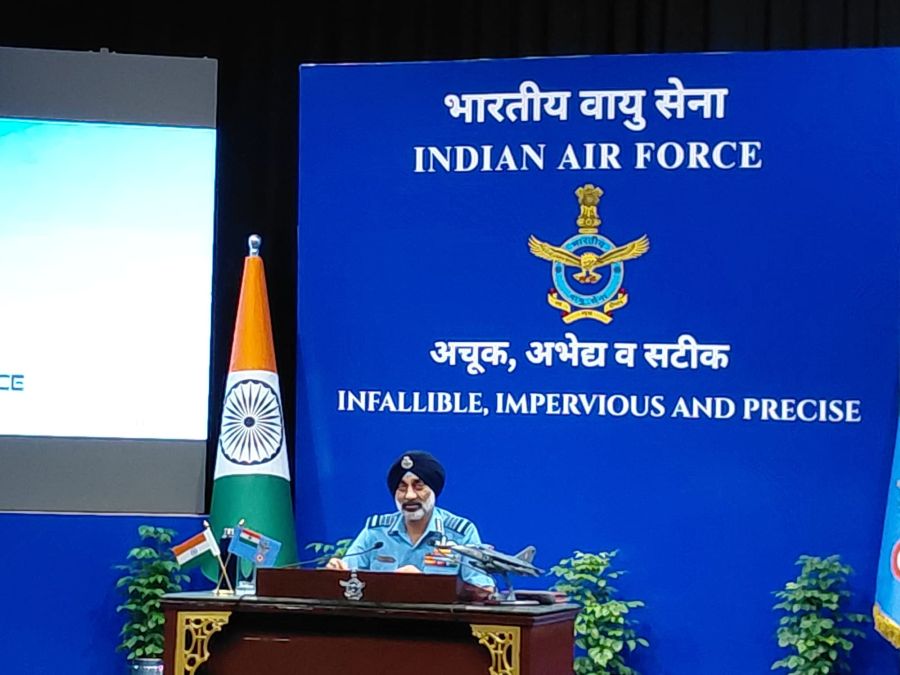
Air Chief Marshal AP Singh, speaking at his annual press conference ahead of Air Force Day on Saturday, was categorical that the IAF has no plans for a separate drone force.
“Drones are not revolutionary to the Indian Air Force, but evolutionary,” he said. “We are growing the number of drones and loitering munitions. Whether we need a separate drone force, I don’t think so.”
His argument was that drones would be most effective when employed alongside other weapons and platforms rather than as a stand-alone arm.
“They should be a part of the same setup, and we have to be operating together,” Singh said. “These have to be together along with other weapons so that they bring in that effect.”
The IAF Chief’s position reflects an operational logic – a drone is not necessarily a capability in isolation. Its effectiveness can depend on how it is connected to intelligence, surveillance and reconnaissance, electronic warfare, artillery, air defence, fighter aircraft, long-range fires and command-and-control networks.
But the American move suggests that operational integration and institutional specialisation need not be mutually exclusive.
US creates Autonomous Warfare Command
US Defence Secretary Pete Hegseth announced on September 30 the creation of the Autonomous Warfare Command, or AutoWarCom, a four-star combatant command with service-like authorities intended to scale autonomous and robotic capabilities across the US joint force.
The proposed command will have dedicated manpower, budget and acquisition authorities and is expected to create specialised career pathways for personnel working in the field. It is intended to bring together drones, artificial intelligence, robotics and associated command-and-control capabilities rather than treating them merely as another weapons category.
Hegseth’s argument is rooted heavily in lessons from Ukraine, Iran and the continuing evolution of warfare.
He acknowledged that “the pace of war is changing faster than the process to support it.” Iran commonly uses cheap drones, including those that have killed US troops during the seven-month war.
Hegseth pointed to Ukraine’s pioneering use of drones to combat Russian forces, something American forces have learned from firsthand.
“Ukraine’s lesson is not that one type of drone wins wars, but rather the need for a purpose-built system that maximises the ability to adapt,” Hegseth said.
The Pentagon has concluded that the issue is no longer simply about acquiring more drones but about creating an institutional system capable of rapidly developing, producing, deploying and adapting autonomous systems at scale.
That distinction is important for India.
The debate should therefore not be reduced to “drone force versus no drone force.” The more consequential question is whether the armed forces have a sufficiently strong institutional mechanism to drive the entire drone ecosystem from technology and acquisition to doctrine, training, mass production, battlefield experimentation and rapid adaptation.
India is already moving towards mass drone warfare
India is not starting from scratch.
The Indian Army has been rapidly absorbing drones, UAVs, loitering munitions and counter-UAS systems. Former Army Chief Gen Upendra Dwivedi had described the objective not merely as buying drones but absorbing them into the way the Army trains, operates and fights.
The Indian Army has also been looking at a tiered and networked drone capability integrated with artillery, air defence, electronic warfare and intelligence systems, an approach broadly consistent with the IAF Chief’s argument that drones should not operate in isolation.
The Navy, meanwhile, is pursuing shipborne unmanned systems, while the IAF is expanding its inventory of UAVs, loitering munitions and other unmanned platforms.
The Defence Acquisition Council’s July 2026 approvals reflected this widening requirement, including a jet-based kamikaze drone system for the Army, naval shipborne unmanned aerial systems and a high-altitude pseudo-satellite capability for the IAF, alongside counter-UAS systems. So the issue is not whether India recognises the importance of drones. It clearly does.
The question is whether the present service-by-service approach is sufficient for the scale and speed of change now taking place.
Operation Sindoor provides an Indian test case
For India, Operation Sindoor provides the most immediate reference point.
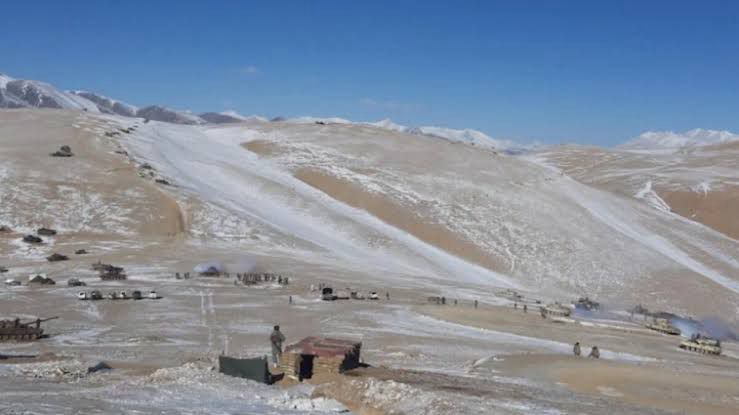
The operation demonstrated the growing importance of unmanned systems, loitering munitions, precision weapons, electronic warfare and integrated intelligence and targeting. The larger lesson is that drones are increasingly becoming part of the entire kill chain rather than simply platforms for surveillance.
That makes the Air Chief’s formulation particularly significant.
His position is essentially that the weapon should be integrated even if the technology requires specialised development.
This is an important distinction.
There is a risk in creating a separate organisation simply because a technology is fashionable. But there is an equal risk in treating a rapidly changing technology as merely another addition to an existing inventory.
The drone revolution is not only about aircraft.
It encompasses autonomous systems, swarming, artificial intelligence, machine-to-machine targeting, electronic warfare, counter-drone systems, communications, sensors, software, data processing and increasingly autonomous decision-support.
The organisation that controls the development of these technologies could therefore be as important as the organisation that operates the drones.
India’s challenge is different from America’s
India cannot simply copy the US model.
The US has a vastly larger defence budget, a global military presence and a different command structure. Its ability to create a four-star combatant command with dedicated manpower, acquisition authority and a separate budget cannot automatically be replicated in India.
But the underlying lesson is relevant.
Hegseth’s announcement explicitly seeks to create an institutional mechanism capable of producing large numbers of affordable, adaptable autonomous systems while connecting operators, engineers and industry in rapid development cycles.
That is precisely where India could face its most difficult challenge.
India’s requirement is likely to be less about a handful of exquisite autonomous platforms and more about mass – affordable, attritable, rapidly replaceable and continuously upgradeable systems.
Lt Gen Raj Shukla (Retd), responding to the US announcement on his ‘X’ post, has argued that India should consider similar moves, including what he describes as a drone-missile force complementing manned air power.
His broader point is worth examining – if drones are going to provide mass and standoff effects alongside expensive manned platforms, then the organisational and industrial architecture supporting them may require a rethink.
The real question: who drives the transformation?
The Air Chief’s statement is therefore less a rejection of drone warfare than a rejection of organisational separation at the operational level.
That may well be the right approach.
But as drone warfare moves from an adjunct capability to a defining component of modern combat, India will need to answer a different question:
Who is responsible for driving the transformation across the entire military?
The US has answered that question by proposing AutoWarCom.
India appears to be answering it through the individual services, with increasing joint integration.
The experience of Ukraine, the current wars in West Asia and India’s own experience in Operation Sindoor suggest that the next phase of drone warfare will be determined not simply by who has the best drone, but by who can design, manufacture, deploy, learn from and replace thousands of them faster than the adversary.
That is why the US move deserves attention in India.
The choice before the Indian armed forces may not ultimately be between a separate drone force and integrated drone operations. It may be between institutional inertia and an institutional mechanism capable of driving autonomous warfare at scale.
Ravi Shankar

Dr Ravi Shankar has over two decades of experience in communications, print journalism, electronic media, documentary film making and new media.
He makes regular appearances on national television news channels as a commentator and analyst on current and political affairs. Apart from being an acknowledged Journalist, he has been a passionate newsroom manager bringing a wide range of journalistic experience from past associations with India’s leading media conglomerates (Times of India group and India Today group) and had led global news-gathering operations at world’s biggest multimedia news agency- ANI-Reuters. He has covered Parliament extensively over the past several years. Widely traveled, he has covered several summits as part of media delegation accompanying the Indian President, Vice President, Prime Minister, External Affairs Minister and Finance Minister across Asia, Africa and Europe.