




India’s indigenous Bhargavastra counter-swarm drone system is nearing completion, with developer Solar Defence and Aerospace Limited (SDAL) conducting its final in-house trials at the Pokhran firing ranges ahead of a planned handover to the Indian Army in January 2027.
The latest development trials, conducted between November 20 and 24, mark a significant milestone for the vehicle-mounted counter-swarm drone system (VMCSDS), which is designed to provide a cost-effective hard-kill response against increasingly sophisticated threats from weaponised unmanned aerial vehicles (UAVs), loitering munitions and autonomous drone swarms.
Developed against the Indian Army’s requirements under a Ministry of Defence (Defence Production) Project Sanction Order (PSO) issued on July 9, 2024, Bhargavastra is being developed under the Make II (Buy Indian IDDM) category. The project carries a completion deadline of March 31, 2027. SDAL is targeting delivery ahead of the stipulated deadline, with January 2027 identified as the handover timeline.
The PSO envisages the development of one prototype set, followed by 12 deliverable sets after successful completion of the prototype demonstration. The system is configured across three Army-inducted vehicles, carrying the weapon launchers alongside integrated sensor, surveillance, command and control systems.
Two-layer defence against drone swarms
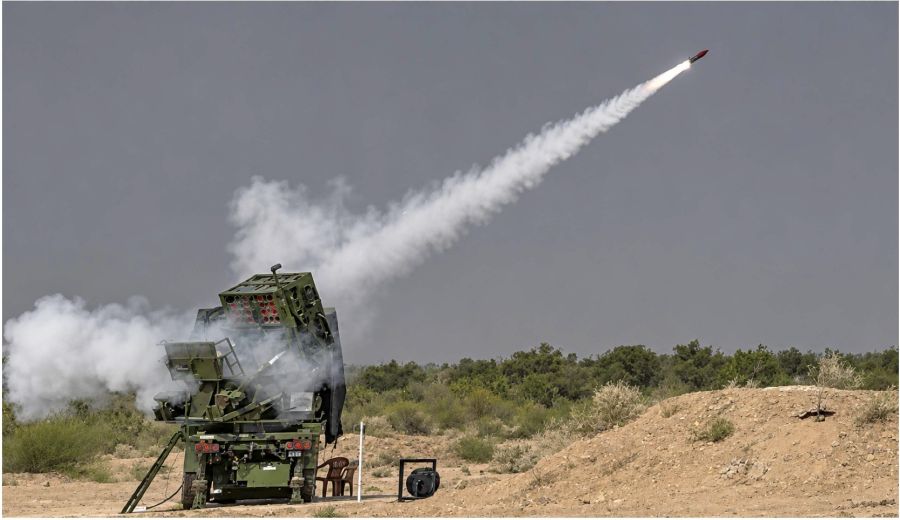
Bhargavastra combines two distinct weapon systems to provide layered protection against aerial threats. Version-I, developed against the Army’s original requirement, employs a 64-tube launcher firing unguided air-defence micro-rockets to engage multiple incoming drones.
Going beyond the initial requirement, SDAL has independently developed Version-II, featuring a 64-missile launcher equipped with guided micro-missiles. These missiles use autonomous guidance and infrared (IR) seekers for precision engagement, adding a more targeted interception capability to the system.
The two configurations are intended to provide complementary engagement options against different categories of drone threats, particularly in situations where conventional electronic countermeasures may prove ineffective.
The system integrates radio frequency (RF) detectors and surveillance radars for detecting and tracking incoming drones. Electro-optical (EO) sensors enable day-and-night target tracking, while an artificial intelligence-enabled command, control, communications, computers and intelligence (C4I) architecture coordinates sensor inputs, target identification, tracking and weapon engagement.
Successful firing against drone targets
During the latest development trials, SDAL conducted multiple firings of both rockets and guided micro-missiles. The rocket-based system was tested against actual swarm-drone targets detected and tracked through its integrated sensors and C4I network. The warheads successfully struck their designated points, demonstrating the system’s ability to engage detected aerial targets.
Separate trials validated the guidance and terminal homing capabilities of the micro-missiles against drones, demonstrating the precision-engagement potential of the second-layer weapon system.
Further optimisation and trials are planned to improve engagement performance and kill probability before the prototype demonstration in its deliverable configuration.
Indigenous development, wider military interest
Bhargavastra has been designed, developed and manufactured in India, including its software, with both the air-defence rockets and guided micro-missiles developed indigenously. SDAL retains complete intellectual property rights (IPR) over the system.
The programme has also attracted interest beyond the Army. Officers from the Indian Navy and Indian Army have observed subsystem evaluations and demonstrations. A ship-based naval variant is also being explored, potentially extending the system’s application to maritime counter-drone operations.
The growing proliferation of low-cost drones and coordinated swarm attacks has created an urgent requirement for affordable interception systems that can deal with multiple targets simultaneously. Conventional air-defence missiles can be disproportionately expensive against small, inexpensive UAVs, while electronic jamming and spoofing may not reliably neutralise autonomous or electronically hardened platforms.
Bhargavastra seeks to address this capability gap through a layered, vehicle-mounted hard-kill solution, combining relatively economical rocket-based interception with precision-guided micro-missiles.
With its development trials nearing completion, the system is moving towards prototype demonstration and the subsequent delivery phase. Its planned January 2027 handover, if achieved, would place an indigenously developed counter-swarm capability with the Indian Army ahead of the project’s March 2027 completion deadline.
Ravi Shankar

Dr Ravi Shankar has over two decades of experience in communications, print journalism, electronic media, documentary film making and new media.
He makes regular appearances on national television news channels as a commentator and analyst on current and political affairs. Apart from being an acknowledged Journalist, he has been a passionate newsroom manager bringing a wide range of journalistic experience from past associations with India’s leading media conglomerates (Times of India group and India Today group) and had led global news-gathering operations at world’s biggest multimedia news agency- ANI-Reuters. He has covered Parliament extensively over the past several years. Widely traveled, he has covered several summits as part of media delegation accompanying the Indian President, Vice President, Prime Minister, External Affairs Minister and Finance Minister across Asia, Africa and Europe.