






The United States says it is moving closer to putting its first sixth-generation fighter jet into production, with the F-47 expected to make its first flight before the end of President Donald Trump’s current term. The claim comes as China continues flight-testing two tailless next-generation combat aircraft, widely referred to as the J-36 and J-50.
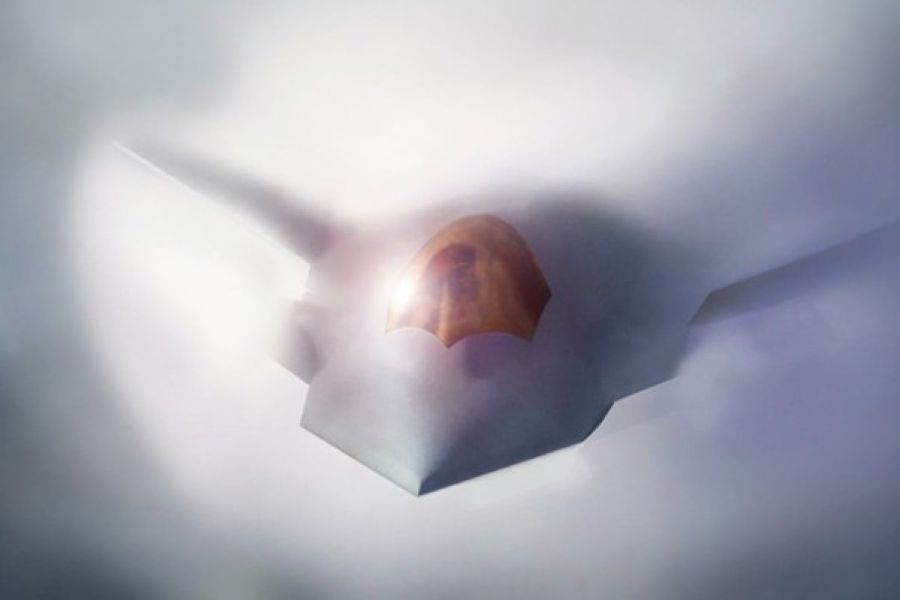
Brigadier General Timothy Helfrich, the US Air Force’s portfolio acquisition executive for fighters and advanced aircraft, said during a Mitchell Institute for Aerospace Studies event on September 28 that Washington was “not too far away” from establishing a production line for the F-47.
He described the aircraft as the “world’s first sixth-generation fighter” and said its first flight was targeted for 2028, before Trump’s term ends in January 2029.
The timeline places the F-47 at the centre of the accelerating US-China competition over the future of air power. China, however, has already put two different next-generation designs through flight testing. The aircraft, identified by Western analysts as the J-36 and J-50, have been observed flying since December 2024.
The lack of detailed information from either side makes a direct comparison difficult. The US has said the F-47 draws on years of classified testing of technology demonstrators, while Beijing has released only limited footage and information on its two new aircraft.
Two different approaches
The Chinese aircraft appear to represent two different approaches to next-generation air combat.
The Chengdu-developed J-36 is a large, three-engine, tailless aircraft with a side-by-side cockpit. The emergence of successive prototypes suggests that Chengdu Aircraft Industry Corporation is continuing to refine the design as flight testing progresses.
The smaller Shenyang aircraft, commonly referred to as the J-50, is considered by analysts to be closer in size and configuration to the F-47.
The distinction is important because the J-36 is substantially larger and appears designed around a different set of requirements. Some analysts have described the aircraft as having no direct US Air Force equivalent at present.
There are also indications that China’s next-generation fighter development is being closely linked to advances in autonomy, networking and unmanned systems.
A research paper published in August by the Shenyang Aircraft Design and Research Institute discussed concepts including greater autonomy, satellite-independent navigation and reconfigurable formations of unmanned aircraft. The paper did not identify the J-50 or confirm that these technologies would be incorporated into it, but the concepts broadly correspond with the US emphasis on teaming manned fighters with autonomous unmanned aircraft.
The F-47 is being developed to operate with Collaborative Combat Aircraft, reflecting a broader US concept in which a crewed fighter would act as the command node for a network of unmanned systems.
“Especially in these highly contested environments, no one’s going to be fighting alone,” Helfrich said.
Boeing gets F/A-XX contract
The US push gained further momentum when the US Navy selected Boeing for its F/A-XX next-generation carrier-based fighter under a development contract valued at more than $20 billion.
Boeing is already the prime contractor for the F-47 programme. The decision effectively places both major US sixth-generation fighter programmes under the same company.
For the US Air Force, the issue is not simply the design of the aircraft but the ability to manufacture it at scale.
Helfrich described fighter production capacity as a “strategic asset”, pointing out that the United States currently has only three active fighter production lines for the F-35, F-15EX and F-16.
The Air Force plans to acquire at least 185 F-47s. The aircraft is expected to have a combat radius exceeding 1,000 nautical miles, or about 1,850 km, while Helfrich has said it will be significantly more survivable than current fifth-generation fighters.
Beyond the first flight
According to experts, the Chinese programmes underline an important distinction in the sixth-generation race – being the first to fly does not necessarily mean being the first to field a mature operational capability.
Flight-testing is only one stage of a long development cycle involving sensors, electronic warfare, weapons, communications, software, autonomy, engines, maintenance infrastructure and production capacity.
The Ukraine war has also demonstrated the growing importance of large inventories of drones, their integration with manned forces and adequate stocks of missiles and other precision weapons. Both Washington and Beijing are likely to be incorporating lessons from the conflict into their concepts for high-end air warfare.
For the US, therefore, the F-47 is being developed not merely as a successor to the F-22, but as part of a broader combat architecture involving manned aircraft, autonomous systems, sensors and long-range weapons.
China’s J-36 and J-50 point towards a similarly networked future, although the limited information available makes it difficult to establish how their operational concepts and technological maturity compare with the American programme.
The emerging contest is consequently less about which aircraft flew first and more about which country can translate advanced prototypes into a connected, survivable and sustainable combat system and produce it in sufficient numbers.
Team BharatShakti