






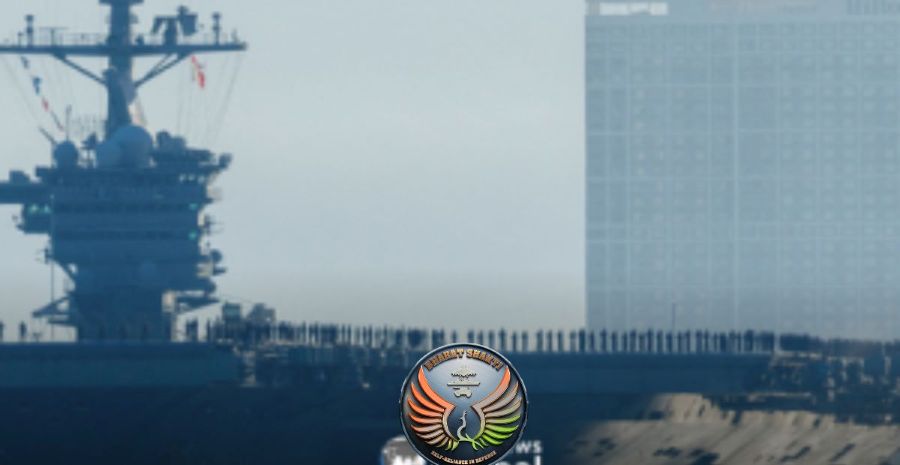
The United States is moving a third aircraft carrier strike group and thousands of additional troops towards the Middle East, significantly strengthening its military presence around Iran as the conflict enters its eighth month.
The latest deployment could put three US aircraft carriers and two amphibious assault groups in waters around Iran by the end of November, giving President Donald Trump a wider range of military options even as Washington and Tehran continue to explore diplomatic avenues.
According to the US military, the USS Theodore Roosevelt carrier strike group departed its San Diego base on Sunday for the region. A day later, the USS Makin Island Marine Expeditionary Unit (MEU) also set sail, carrying more than 2,000 Marines.
The Wall Street Journal has reported that the latest naval deployments could bring an additional 9,000–10,000 US personnel into the region, including sailors and Marines attached to the carrier strike group and other vessels.
The deployment includes F-35 stealth fighters and comes on top of an estimated 50,000 US military personnel already stationed across the Middle East.
The scale of the reinforcement suggests Washington is seeking to retain a credible military option irrespective of the outcome of diplomatic negotiations. The Pentagon is reportedly not planning to withdraw the newly deployed assets even if an agreement with Tehran is reached.
US Defence Secretary Pete Hegseth has said American forces are “ready to go” should Trump order further military action.
The latest naval movement follows months of reinforcement of US airpower in the region.
Open-source intelligence analysts and aircraft tracking data indicate that the US has deployed more than 120 aircraft to the Middle East since early February, representing one of the largest increases in American airpower in the region since the 2003 Iraq War.
The deployments have included F-35 and F-22 fighters, F-15 and F-16 aircraft, E-3 Sentry AWACS platforms, aerial refuelling tankers and strategic airlift aircraft.
The movement of combat aircraft alongside tankers and transport aircraft points to the ability to sustain operations over an extended period rather than merely rotating individual squadrons, military analysts have said.
The Pentagon had also ordered additional forces to the Gulf in March.
These included the Tripoli Amphibious Ready Group, centred on the America-class assault ship USS Tripoli and the 31st MEU, and the Boxer Amphibious Ready Group, built around the USS Boxer and the 11th MEU.
Together, the two Marine formations brought about 4,500 Marines and sailors into the region. A further contingent of approximately 2,000 soldiers from the 82nd Airborne Division’s Immediate Response Force was also deployed.
Nearly 7,000 additional US personnel have therefore been moved into the Middle East since the war with Iran began.
The planned concentration of naval power is significant.
By November, the US could have three carrier strike groups and two amphibious formations positioned within operational reach of Iran. Such a force would provide Washington with a combination of long-range airpower, maritime strike capability, air defence, surveillance and Marine Corps forces capable of conducting amphibious operations.
The presence of multiple carrier groups also provides greater flexibility in sustaining air operations while allowing individual formations to rotate, refuel or reposition without removing US naval aviation capability from the region.
The United States has maintained a substantial military footprint in the Middle East for decades. According to the Council on Foreign Relations, American forces operate from a network of permanent and temporary facilities spread across at least 19 locations.
Permanent US bases are located in countries including Bahrain, Egypt, Iraq, Jordan, Kuwait, Qatar, Saudi Arabia and the UAE.
The military build-up comes against the backdrop of stalled diplomatic efforts.
Iran recently proposed reopening the Strait of Hormuz within seven days, subject to conditions including the lifting of sanctions, unfreezing Iranian assets and guarantees that US strikes would end.
The Trump administration rejected the proposal, with Washington seeking discussions on wider issues, including Iran’s nuclear programme.
Trump told Time magazine that he had rejected the latest Iranian ceasefire proposal because it contained provisions he would not have accepted previously or accept now. Asked whether the US could intensify bombing after the November midterm elections, Trump said it was “possible”, but declined to provide details.
The US has simultaneously intensified economic pressure on Tehran. Washington this week imposed sanctions on Iranian rail and automotive conglomerates, while broader sanctions announced last month targeted Iran as well as entities in other countries trading with it.
Signalling or preparation?
The central question now is whether the latest deployment represents military signalling intended to strengthen Washington’s negotiating position or preparation for a wider phase of the conflict.
The answer remains unclear.
A large US force concentration can serve both purposes. Carrier groups, amphibious forces and additional aircraft give Washington greater military flexibility while also increasing pressure on Tehran to negotiate from a position shaped by the possibility of further military action.
For Iran, however, the arrival of additional US forces close to its coastline raises the stakes around the Strait of Hormuz and the wider Gulf region.
With three US carriers and two amphibious groups potentially in the region by November, the military balance around Iran is entering a potentially more consequential phase, while the diplomatic track remains unresolved.
Team BharatShakti