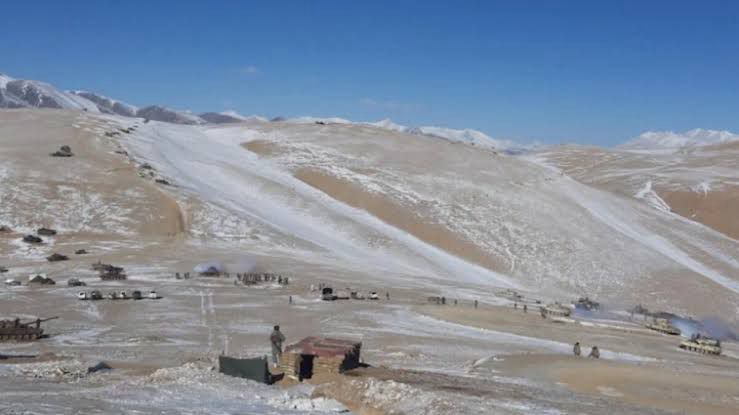
India has formally identified and standardised the names of 28 places and geographical features in Ladakh on the official maps of the Survey of India, including Gogra and Hot Spring, two locations that figured prominently in the India-China military confrontation along the Line of Actual Control (LAC) in 2020.
The move, announced by the government on Friday, was undertaken in consultation with the Union Territory administration of Ladakh. It is aimed at ensuring standardised names and accurate cartographic identification of locations in the strategically sensitive frontier region, while also improving public awareness of these geographical features.
The Ministry of Home Affairs said the government had identified the 28 places/features “by standard place and feature names” on the official Survey of India map of Ladakh.
The government said the formal inclusion of these names on Survey of India maps would facilitate their accurate recognition and wider awareness among the public.
The exercise comes amid India’s continuing efforts to strengthen its official mapping and documentation of frontier areas. It follows a similar exercise in Arunachal Pradesh in August 2026, when India standardised the names of 27 geographical features in the state.
While the latest exercise is essentially cartographic and administrative, the locations involved have significance in the broader context of India’s boundary management with China. Gogra and Hot Spring, in particular, were among the friction points during the 2020 India-China military standoff in eastern Ladakh.
The 28 features identified in Ladakh cover a wide range of geographical categories, including peaks, mountains, passes, glaciers, valleys, rivers, lakes and land areas.
The 28 locations
Peaks and mountains: Atisha Giri, Kanishka Peak, Martand Giri, Zorawar Peak, Rinchen Zangpo, Sakyasri Giri, Marpa Lotsava Ri, Milarepa Kangri, Shiva Ri, Maheshvara Ri, Drak Karpo, Karun Pir and Jolmori.
Passes and glaciers: Chapchingal Pass, Shachmirk Pass, Parpik Glacier and Skamri Glacier.
Valleys, rivers, lakes and land areas: Brangsa, Kuksel, Shkorga Valley, Dehra Compass, Gogra, Kumarayana Point, Panglung, Shamal Lungpa, Yangpa River, Guru Rinpoche Lake and Hot Spring.
The naming exercise also includes Zorawar Peak, named after the 19th-century Dogra military commander General Zorawar Singh, whose campaigns extended into Ladakh and the western Himalayas.
The government’s move comes against the backdrop of China’s periodic attempts to assign its own names to geographical features in territories claimed by Beijing but administered by India. New Delhi has consistently maintained that such renaming exercises do not alter the ground reality or India’s sovereign position over the territories concerned.
The formal recording of Indian names on Survey of India maps therefore adds another layer to India’s official documentation of frontier geography, alongside physical deployment, infrastructure development and boundary management.
The Ladakh exercise also underlines the growing importance of precise geographic identification in a region where patrol routes, mountain features, passes and valleys have direct implications for military operations and the management of the LAC.
The government, however, has not described the exercise as a change in territorial status. It has presented the move as one of standardising official geographical names and improving accurate recognition of locations within the Union Territory of Ladakh.
Ravi Shankar
Dr Ravi Shankar has over two decades of experience in communications, print journalism, electronic media, documentary film making and new media.
He makes regular appearances on national television news channels as a commentator and analyst on current and political affairs. Apart from being an acknowledged Journalist, he has been a passionate newsroom manager bringing a wide range of journalistic experience from past associations with India’s leading media conglomerates (Times of India group and India Today group) and had led global news-gathering operations at world’s biggest multimedia news agency- ANI-Reuters. He has covered Parliament extensively over the past several years. Widely traveled, he has covered several summits as part of media delegation accompanying the Indian President, Vice President, Prime Minister, External Affairs Minister and Finance Minister across Asia, Africa and Europe.