





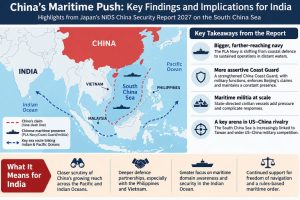
China’s expanding maritime power in the South China Sea is reshaping the Indo-Pacific balance of power.
Through a combination of naval expansion, coast guard deployments and maritime militia operations, Beijing is extending its influence while challenging the freedom of manoeuvre of other regional powers.
For India, the implications go beyond Southeast Asia: China’s growing ability to project power across the Pacific and Indian Oceans could alter the maritime balance much closer to India’s shores.
These developments are examined in the NIDS China Security Report 2027: China and the South China Sea – The Dynamics of Maritime Issues, published in November 2026 by Japan’s National Institute for Defence Studies (NIDS).
The report is led by Shoji Tomotaka, Director of NIDS’s Department of Area Studies, with contributions from Iida Masafumi, Director of its Department of Advanced Domain Studies, and Goto Yohei, Research Fellow in its China Division.
Shoji examines the evolution of the dispute, Sino-US competition and Southeast Asian responses; Iida analyses China’s naval strategy; and Goto examines the expanding military and administrative role of the China Coast Guard.
Their assessment is that China’s maritime expansion has become a central challenge to the regional security order.
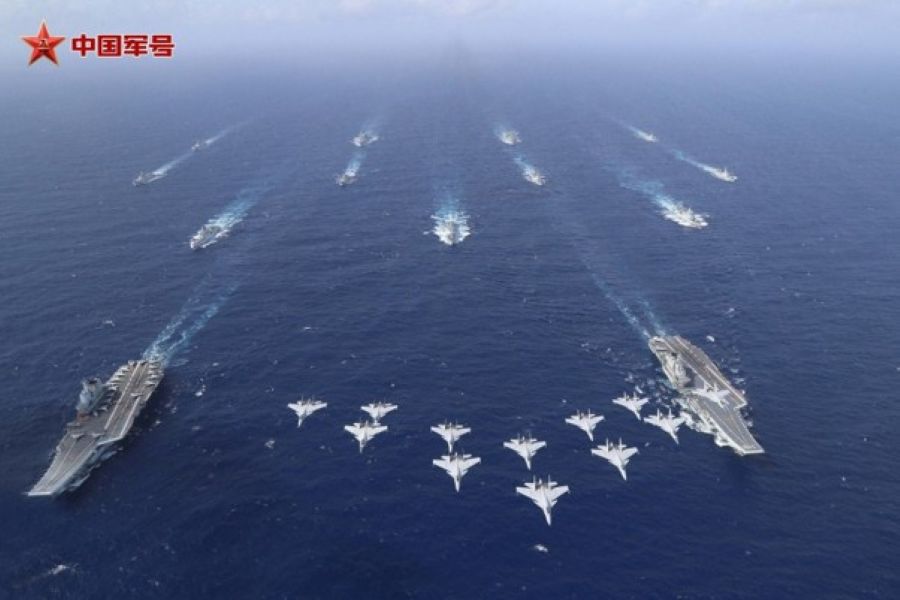
One of the report’s central findings is the transformation of the People’s Liberation Army Navy (PLAN). China’s naval strategy has evolved from coastal defence to near-seas operations and, increasingly, the ability to operate in distant waters.
Since the mid-2000s, Beijing has pursued a combination of near-seas defence and far-seas protection, with greater emphasis on the latter since 2020. The development of aircraft carriers, nuclear-powered submarines, advanced destroyers and replenishment vessels has strengthened the PLAN’s capacity for sustained operations beyond the First Island Chain.
The transformation reflects China’s expanding overseas interests, dependence on maritime trade and the need to protect energy supplies and shipping routes.
But it also has a military dimension. The South China Sea is important to China’s ability to constrain US military operations approaching through the Pacific and Indian Oceans, as well as to protect its submarine-based nuclear deterrent.
The India Connection
For India, this presents a longer-term maritime challenge. The Indian Navy has traditionally benefited from its geographical position in the Indian Ocean, particularly around the approaches to the Malacca Strait. However, China’s growing ability to sustain naval operations across the western Pacific and into the Indian Ocean could complicate India’s calculations. The two maritime theatres are increasingly interconnected.
The report identifies the China Coast Guard (CCG) as a particularly important instrument of Beijing’s maritime policy. Its consolidation in 2013, incorporation into the People’s Armed Police in 2018 and the enactment of the Coast Guard Law in 2021 have given it a combination of administrative and military functions.
The CCG has acquired larger vessels and military-grade equipment, while its coordination with the PLAN has strengthened. This allows Beijing to enforce its maritime claims, obstruct rival vessels and maintain a persistent presence in contested waters without necessarily deploying conventional naval forces.
Maritime Militia
The maritime militia adds another layer. Fishing and other civilian vessels operating under state direction can support Chinese maritime operations and complicate the responses of rival claimants.
The report argues that Beijing uses the Coast Guard not merely to enforce maritime law but also to create an appearance of administrative legitimacy for its claims. Its activities around Scarborough Shoal, disputed with the Philippines, illustrate this approach.
For India, the significance lies in the changing nature of maritime competition. The challenge is no longer confined to conventional naval deployments. Coast Guard vessels, fishing fleets and ostensibly civilian platforms can also be used to advance state objectives. This makes maritime domain awareness, surveillance and information-sharing with regional partners increasingly important.
The report traces the intensification of the South China Sea dispute to China’s growing maritime presence and the militarisation of artificial islands in the mid-2010s. The United States responded through freedom of navigation operations, military exercises and closer security cooperation with regional partners.
The confrontation has since become more entrenched, with the South China Sea and Taiwan Strait increasingly treated as interconnected theatres of military competition.
For Beijing, the South China Sea is important not only for its territorial claims but also for its ability to constrain US military intervention in a Taiwan contingency. The report notes that the area could become critical to a Chinese maritime blockade of Taiwan and operations against US forces approaching from the Pacific and Indian Oceans.
For India, a confrontation in the western Pacific would have consequences beyond the immediate theatre. Disruption of commercial shipping, pressure on energy supplies and the movement of naval forces could affect India’s economic and security interests. New Delhi’s emphasis on freedom of navigation, respect for international law and peaceful resolution of maritime disputes is therefore directly relevant to the evolving situation.
Differing Responses
The report highlights the differing responses of the Philippines, Vietnam and Malaysia to China’s maritime pressure.
The Philippines, under President Ferdinand Marcos Jr has adopted a more confrontational posture, expanding defence cooperation with the United States, Japan and Australia. Vietnam, despite its history of clashes with China, has prioritised stable relations with Beijing while diversifying its security partnerships. Malaysia has maintained a comparatively moderate approach, balancing its maritime interests against substantial economic ties with China.
These differences have complicated ASEAN’s efforts to develop a unified response. Negotiations with China over a Code of Conduct have made limited progress, with disagreements persisting over its geographical scope and whether it should be legally binding.
The common concern, however, is that none of these countries can afford to depend exclusively on China. Maintaining relations with both Beijing and other major powers remains central to their efforts to preserve strategic autonomy.
This creates space for India to deepen its engagement with Southeast Asia without asking regional countries to choose sides in the US-China rivalry.
The report specifically notes India’s growing defence cooperation with the Philippines and Vietnam.
BrahMos and Beyond
The Philippines has acquired BrahMos supersonic cruise missiles from India. During President Marcos’ visit to New Delhi in August 2025, the two countries established a Strategic Partnership and conducted their first joint sail in the South China Sea. The report sees this as part of the expanding network of partnerships supporting Manila’s efforts to protect its maritime interests.
India’s defence relationship with Vietnam has also widened across the three services. Cooperation includes military training, naval port calls, bilateral exercises and aircraft maintenance support. Vietnam is also pursuing an agreement to acquire BrahMos missiles from India, valued at approximately $700 million.
These partnerships demonstrate that India’s Indo-Pacific engagement is moving beyond diplomatic declarations towards practical defence cooperation. They strengthen the capabilities of regional partners while expanding India’s position as a defence supplier and security partner.
The challenge for New Delhi will be to deepen these relationships without becoming directly drawn into territorial confrontations. Its approach has been to support international maritime norms, strengthen regional capacities and preserve its freedom of action.
The larger message of the NIDS report is that China’s maritime expansion is not driven by naval power alone. It involves the coordinated use of military forces, law enforcement agencies and civilian-linked maritime assets to gradually consolidate control without necessarily triggering open conflict.
For India, the implications are clear. The Indian Ocean and western Pacific can no longer be treated as separate security theatres. China’s ability to operate across both has consequences for India’s maritime security, trade and regional partnerships. The South China Sea may be distant from India’s shores, but the balance of power taking shape there will increasingly influence India’s own security environment.
Ramananda Sengupta
(Source: NIDS China Security Report 2027, National Institute for Defence Studies, Japan, November 2026)
Read the full report

In a career spanning three decades and counting, I’ve been the foreign editor of The Telegraph, Outlook Magazine and the New Indian Express. I helped set up rediff.com’s editorial operations in San Jose and New York, helmed sify.com, and was the founder editor of India.com. My work has featured in national and international publications like the Al Jazeera Centre for Studies, Global Times and Ashahi Shimbun. My one constant over all these years, however, has been the attempt to understand rising India’s place in the world.
I can rustle up a mean salad, my oil-less pepper chicken is to die for, and it just takes some beer and rhythm and blues to rock my soul.