




Editor’s Note
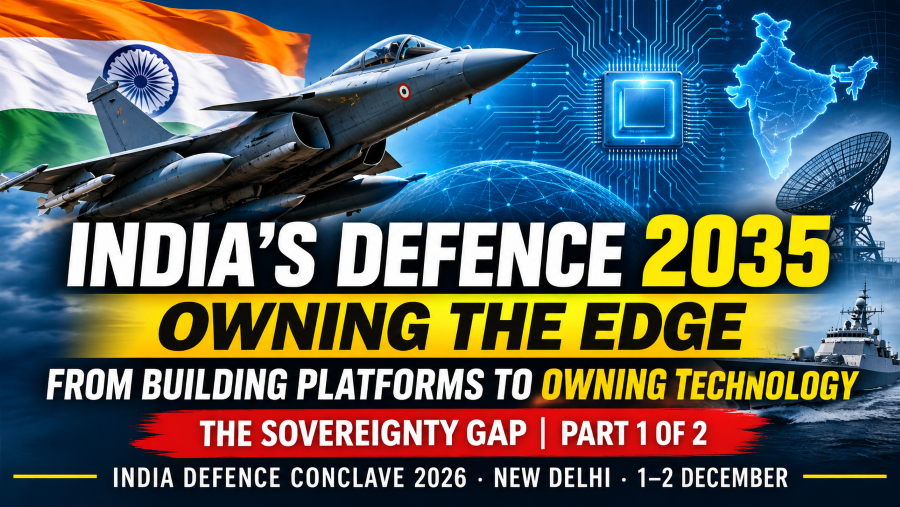
India’s defence indigenisation story has made impressive strides, but manufacturing platforms at home is not the same as owning the technologies that power them. As warfare becomes increasingly defined by semiconductors, artificial intelligence, electronic warfare and advanced sensors, strategic dependence in these critical areas could undermine hard-won gains in self-reliance. Ahead of the 11th India Defence Conclave, this two-part series examines the sovereignty gap, draws lessons from countries that have successfully mastered niche defence technologies, and makes the case for prioritising investments. Part I identifies the gaps and proposes where the first Rs 10,000 crore should go. Part II lays out a roadmap for India to own the technological edge by 2035.
From Building Platforms To Owning Technology: The Sovereignty Gap
Every combat aircraft lives two lives. The first is made of metal and composite, and it lasts forty years. The second is made of chips, microwave power, software and data, and it is rewritten every few years, sometimes every few weeks.
India has become good at the first life. It builds fight‐ers, warships, missiles and guns, and it builds more of them each year. The second life is where wars are now decided, and there India still borrows too much.
Our argument is simple. India cannot become a defence industrial power by indigenising platforms alone. It must own the intellectual property, design authority, semiconductor backbone, artificial-intelligence stack, and the electronic warfare ecosystem that will decide military advantage in theatres of war in 2035.
We come to these technologies from different directions, one from a lifetime in business of technology and the other from a lifetime in operationalising technology in Air Force uniform. In this first of two articles, we put data on the gap, show where such gaps have been closed, and identify where the first rupee should go. The second sets out the plan.
One comforting number, five uncomfortable ones
The headline figure is comforting. The Ministry of Defence says 65 to 70 per cent of India’s defence needs are now met at home. Look one level down, at what sits inside the equipment, and the picture changes. Figure 1 sets the comforting number beside five uncomfortable ones.
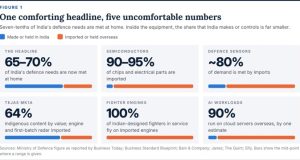
The pattern is plain. India is most self-reliant where the technology is oldest, and most dependent where the fight is decided.
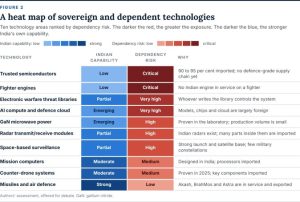
We could not find an official figure for import share by subsystem: radar, electronic warfare, microwave, mission systems. So the first reform we propose costs almost nothing. Publish a dependency index each year, weighted by how critical a component is and not by what it costs.
Our own reading is set out in Figure 2, drawn from the numbers above and from our work with these technologies. It is a first draft for the Services and the laboratories to correct.
Proof that it can be done
None of this is a counsel of despair. India has shown, more than once, that it can own a difficult technology from drawing board to export order.
DRDO’s Uttam radar will replace the Israeli set on the second batch of 97 Tejas Mk1A aircraft, alongside an Indian electronic warfare suite. The Akash missile system was singled out in the official account of Operation Sindoor, and Armenia became its first foreign customer. The Philippines bought BrahMos in 2022 for 375 million dollars; Vietnam and Indonesia signed this year. The Astra air-to-air missile found its first export customer in Indonesia.
Look at what these have in common. In each case India owned the design, or in the case of BrahMos co-owned it. In each case a patient customer, usually one of the Services, stayed with the program through its early failures. And in each case the export order came after the technology was owned, never before.
The successes cluster in missiles and radar. The task now is to repeat them in chips, microwave power, electronic warfare and artificial intelligence.
What others did first
Four countries have made the journey from buyer to builder in living memory. They took different roads, but they made the same first move.
Israel never set out to build everything. It concentrated on what goes inside the platform: radars, electronic warfare, seekers and avionics. Its defence exports reached a record 19.2 billion dollars in 2025. Israel flies American fighters and fills them with its own electronics.
Türkiye began with drones and defence electronics, and came to engines later. Its defence and aerospace exports rose from 248 million dollars in 2002 to just over 10 billion in 2025.
South Korea learned the hard way. In 2015 the United States declined to supply an electronically scanned radar for Korea’s new fighter. Seoul chose to develop its own, and by 2023 a Korean firm was exporting such radars. The fighter still flies on American engines.
China, in the late 1990s, was judged weak in microelectronics, sensors, electronic warfare and engines alike. It attacked electronics first, by fusing its civil chip and telecom industries with its defence electronics groups. Engines were the last piece to mature.
The lesson is the same in all four. Leadership in niche technology comes before leadership in platforms. None of them waited for an engine before mastering the electronics, and that is why they win when and where it matters.
Where would we invest the first Rs 10,000 crore?
A list of technologies is not a strategy. A policy-maker with a finite budget needs an order. We suggest a rubric that anyone can apply and argue with.
Score each technology from 1 to 5 on four questions, and multiply the answers. How much does it change the outcome of a fight? How many other systems does it unlock? Will the world buy it? Can India get there within five years with the people and laboratories it has?
A technology that scores near zero on any one question falls down the list. That is deliberate. It stops money flowing to things that are vital but out of reach, or reachable but unimportant.
Figure 3 shows our scoring, out of a possible 625, and how a first Rs 10,000 crore would divide.
Three things stand out. The top three are all about chips and microwave power. They feed every radar, jammer, seeker and data link India will build, and the world will buy them. About half of a first Rs 10,000 crore belongs there.
Electronic warfare scores lower than its importance suggests, and the reason is instructive. Threat libraries are national secrets and cannot be exported. They are also cheap. What they need is access, test ranges and trained people more than capital.
Engines come last, and that will surprise many readers. Engines matter enormously. They score low only because success within five years is unlikely at this budget. They need a separate national mission with its own money, because this is a long-term play.
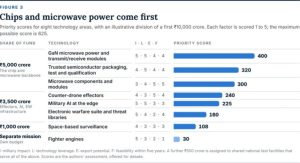
The scores are ours and are meant to start the argument. Different judges will score differently, and they should. But India needs the argument now. An aircraft built in India around someone else’s chips and someone else’s threat library is an Indian airframe carrying a foreign mind.
Sanjay Viswanathan (Chairman of London-based AdiGroupè and India-based AdiTech Semiconductors) and Air Vice Marshal Vikas Dwivedi, VSM (Retd) (Business Leader-Aerospace & Defence, at India-based AdiTech Semiconductors and Vice Chairman of Indo-UK AdiTech–SARAS Joint Venture)