


Editor’s Note
As Artillery assumes a central role in modern warfare, the Indian Army faces a growing contradiction within its own ranks. Despite the increasing importance of firepower, officers from the Artillery continue to be underrepresented at senior leadership levels because of longstanding promotion and cadre policies. The author contends that this may affect operational efficiency.
A couple of months back, I had posted on X, a platform I rarely use, “Firepower and Manoeuvre are the 2 basic elements in a battlefield. Today, Firepower is the predominant element with Manoeuvre exploiting opportunities created by Firepower”. I had gone on to write, “Need to have a heavier rep (representation) of officers with greater experience in dealing with Firepower in the top rungs.”
Firepower’s Pre-eminence in Ukraine & Iran War
The Ukraine War was expected to be short and swift, and yet it has continued at its own pace since 24 February, 2022. The war proves that even when the contestants bring to bear hugely uneven combat strengths, the days of short, swift, and violent progression on the battlefield through manoeuvre forces are over.
In fact, the Ukraine war today resembles the trench battles of World War I. A massive concentration of firepower needs to be applied to an objective before manoeuvre forces can attempt to breach it.
When the US-Iran war is analysed, employment of firepower, and the utilisation of drones, air power, missiles, and conventional munitions stand out prominently.
The entire battle has been executed through firepower. Whether it was the decapitation of leadership or destruction/burial of infrastructure for suspected enrichment facilities, missile launch and manufacturing sites and other objectives to include economic targets, it was achieved through the precision use of firepower by various modes of delivery.
Another lesson of great relevance from the Iran War is the indispensable need for reliable intelligence to undertake targeting. Obviously, the elements primarily entrusted with delivery of firepower need to have integral Intelligence, Surveillance and Reconnaissance (ISR) capabilities,
The entire operational plan in the Ukraine War has been based on the use of firepower to create an advantageous situation for exploitation by manoeuvre forces. When manoeuvre forces were employed without adequate firepower being applied against the opponent, success proved elusive.
It happened when the Russian armoured formation tried to race to Kyiv to achieve a political goal: replacing the leadership in the capital and perhaps even the flag. The Ukrainians used their drones and artillery to put the brakes on the Russian manoeuvre effectively. A similar situation was encountered in the eastern region of Ukraine.
Initially, multiple Russian thrusts breached the Ukrainian lines, but their advance was soon halted, and a grinding battle for inch-by-inch of ground began.
Both wars demonstrate the need to strengthen, reorganise, and restructure India’s artillery. A lot of work has happened in this regard. UAVs have been inducted, precision munitions co-opted, and longer ranges for both tube and rocket artillery are being pursued. A complete revamp of the artillery, giving it a capability leap, is underway.
Rocket Force
For some time, the creation of a Rocket Force has been debated by the services. Such forces exist in countries like China and Russia. The Pakistani Prime Minister announced the creation of such a force in February 2025. The Army Rocket Forces Command of Pakistan is meant for centralised control over its large rocket and land-based missile systems. The nuclear assets will remain with the Army Strategic Forces Command.
The then Indian Army Chief, Gen Upendra Dwivedi, in a press conference ahead of Army Day in January 2026, also announced that India was considering raising a similar force. However, there is another school of thought: with three Artillery Divisions already in the inventory, does India need to raise a new, separate Rocket Force? Or is there a need to raise more of these Artillery Divisions?
The ultimate structure India works out to enhance the efficacy of firepower needs to be objectively arrived at. However, if these most critical resources are to be employed by the best professionals, the Army’s higher leadership also needs to ensure that its Human Resource policies and promotion system are objective.
Languishing Career Prospects of Gunner Officers
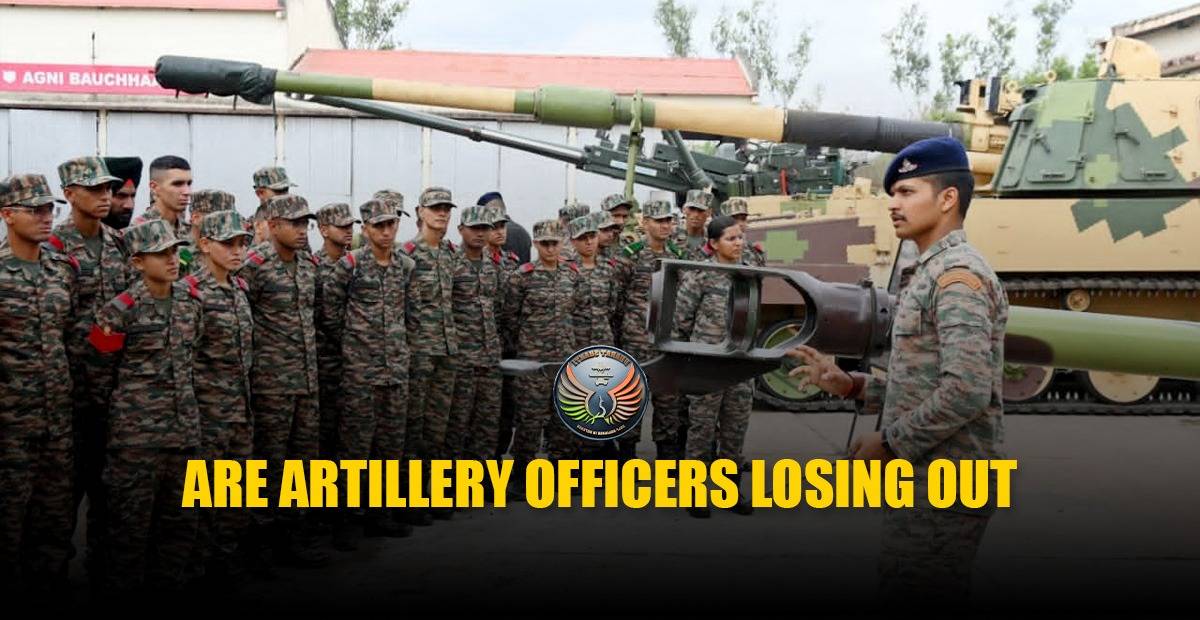
In keeping with the trend of increasing importance of firepower on the battlefield, it was expected that more Gunner (Artillery) officers would rise to flag ranks to provide the best leadership, since they have in-depth exposure to conceptualising the application of firepower. However, the promotion process in the Indian Army is witnessing an exact opposite journey.
As Maj Gen Harsha Kakar, a retired Gunner officer, writes, “In the Indian Army, artillery officers appear to be increasingly sidelined at apex levels. Currently, most senior artillery officers are kept away from the mainstream, posted largely to non-combat establishments, reducing numbers needed to manage complex operations.”
It is important to understand the selection process for higher ranks. Officers of the artillery are selected for the General Cadre when promoted to Brigadier. Only a chosen few of these approved Brigadiers are offered an option into that hallowed domain of General Cadre, where Infantry, Mechanised Infantry and Armoured Corps officers automatically gain entry on being approved as one star. Because of the stringent yardsticks applied to Gunners, many amongst this crème de la crème lot of Artillery officers fail to reach the rank of Maj Gen or higher.
The million-dollar question begging for an answer is: how are the best Gunner officers being found professionally inadequate?
Lt Gen KR Rao, retired DG Artillery, makes an interesting observation in his recent article. He wrote on 15 June in Times of India.com, “Artillery, the second largest combat arm, constitutes 28 per cent of the cadre of arms officers, with Infantry constituting 40 per cent, when it comes to Lt Generals, Infantry has 57 as on date, with Artillery relegated to meagre four.”
In an organisation famous for its pyramidical structure, competition is extremely intense. In such a situation, if one of the lethal arms of the Army begins to feel discriminated against, an impact on operational efficiency is to be expected sooner or later.
Urgent Measures Required
The immediate requirements are two. Firstly, Artillery should be given the status of a combat arm. ‘Combat Support’ arm is not the correct lingua franca. Application of fire to cause the right degree of destruction of the enemy in both close and deep battle, along with ISR capabilities, drones, and air power, will be critical for overwhelming the enemy.
Secondly, the narrow, outdated confines of the General Cadre need to be reviewed and expanded. Artillery officers should be considered to be in the General Cadre, like their Infantry or Armoured Corps counterparts. Retention of turf and beret badges casting a shadow on such professional issues would be most unprofessional and a slur on the good name of the Indian Army.
For decades, the explanation given to all officers when promoted to the rank of Brigadier and above about discarding their regimental beret badges and adopting a common cap badge has been purely symbolic.
As the officer grows in service, he is expected to develop a broader vision and to leave behind his regimental leanings while taking professional decisions that involve the Services as a whole. The decision to automatically induct Artillery officers into the General Cadre would be a right step in that direction and would be professionally ethical.
Finally, to add a footnote: No one is denying the need to strengthen regimental spirit; however, that’s for another day, for a regimental function perhaps.
Views expressed in this article are personal.
Brig SK Chatterji (Retd)

The officer was commissioned into the Regiment of Artillery after graduating from the Indian Military Academy.
A graduate of the Defence Services Staff College and the Army War College, he commanded a medium artillery regiment in a high-altitude sector and later an artillery brigade in the desert.
He retired as Deputy Director General (Strategic Communication) at Army Headquarters.
A prolific defence commentator, he is the author of Vintage Guns of India' and has co-authored and edited several other books.
His articles on defence and strategic affairs have appeared in leading newspapers and military journals in India and overseas.
Following his retirement from the Army, he served at the apex level of an Indian multinational before becoming the founding editor of BharatShakti, a role he held for over a decade.